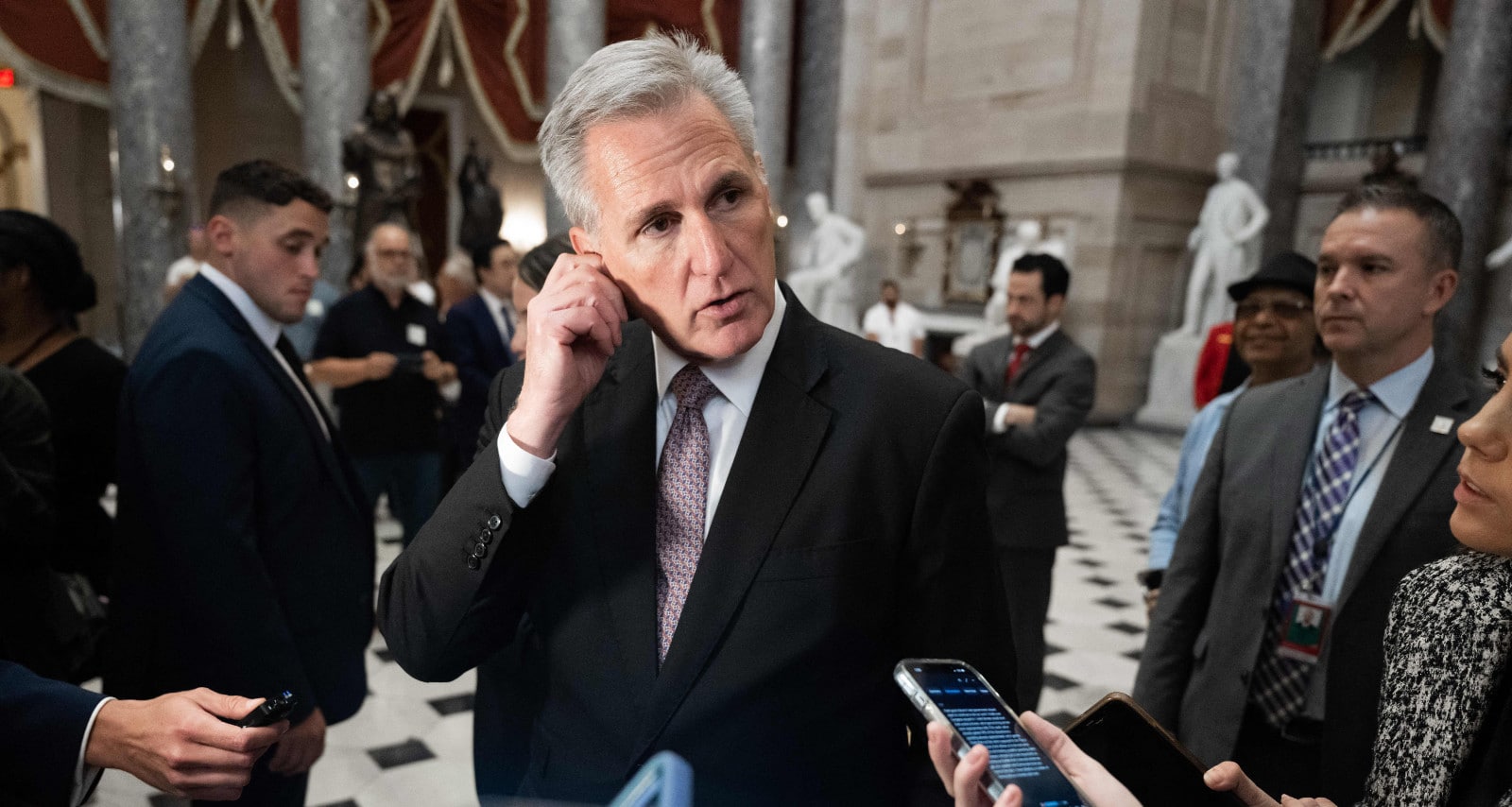
Immediately after the House on Tuesday voted to vacate now-former House Speaker Kevin McCarthy’s (R-Calif.) seat a new acting speaker was named: Rep. Patrick McHenry (R-N.C.), an ally of the California Republican.
“The speaker pro tempore is imbued with all the powers of an elected speaker of the House. McCarthy hand-picked McHenry (R-N.C.) for this role when he was elected speaker in January. The pro tempore is kept as a secret, held by the clerk of the House, until a speaker is removed or incapacitated, a process designed after Sept. 11, 2001, to ensure continuity of government,” Politico reported.
The final vote was 216 to 210 to oust McCarthy; eight Republicans voted with all present Democrats to remove him.
“This is the first time that [the] temporary replacement process has ever been carried out, following a speaker being forced out. As an acting speaker, McHenry is not in the line of succession for the presidency. Just like any acting Cabinet secretary, McHenry would be skipped,” the outlet continued.
McHenry, a trusted confidant of McCarthy, played a crucial role in January as a primary mediator between various House Republican groups, helping secure the necessary votes for McCarthy’s election as Speaker. He also held a central position in McCarthy’s negotiation for a debt limit agreement with President Joe Biden, a move that drew criticism from conservative factions within the GOP conference and contributed to their effort to oust McCarthy from the Speaker’s position, Politico added.
Now what happens? NBC News provided an update:
Since 2003, House rules have required the speaker to submit a list of names to the clerk of members to act in the case of his or her vacancy. According to Rule I, clause 8 of the House rules, the next person on that list “shall act as Speaker pro tempore until the election of a Speaker or a Speaker pro tempore.” We now know that’s Patrick McHenry; he’ll take over as speaker in an acting capacity.
This is a different situation than in January, when the House started a new session and could not start any legislative business until a speaker was elected. Because it was the beginning of a new Congress, the House needed to elect a speaker in order to swear in members and pass the rules package.
“McHenry suggested that members should meet in their party conferences before deciding on the path forward. An election for a permanent speaker could be delayed until the House is better prepared,” the outlet noted further.
McCarthy acknowledged the difficulty of his situation before the vote.
When asked if it was likely that five Republicans would vote with the Democrats, McCarthy replied, “Probably so,” meaning that he would resign if that happened. He claimed that he does not anticipate support from Democrats.
House Minority Leader Hakeem Jeffries made it clear on social media that Democrats won’t save McCarthy.
“House Democrats will continue to put people over politics. We are ready to find bipartisan common ground. Our extreme colleagues have shown no willingness to do the same. They must find a way to end the House Republican Civil War,” Jeffries posted on X, formerly known as Twitter.
“Democrats are going to continue to push for people over politics and to fight to make life better for everyday Americans. From the very beginning, that has been our objective. And it will continue to be our sole focus delivering for the American people. We encourage our Republican colleagues who claim to be more traditional to break from the extremists, end the chaos, end the dysfunction, end the extremism,” Jeffries said.
Previously, McCarthy told CNN he wouldn’t cobble together a coalition speakership with Democrats.
“That doesn’t work. I’m a conservative; I’m a Republican. I’m a conservative who want to get things done. I know we live in our governments designed to have compromise but look, we are in the majority. You don’t surrender,” he said.
This article may contain commentary which reflects the author's opinion.
