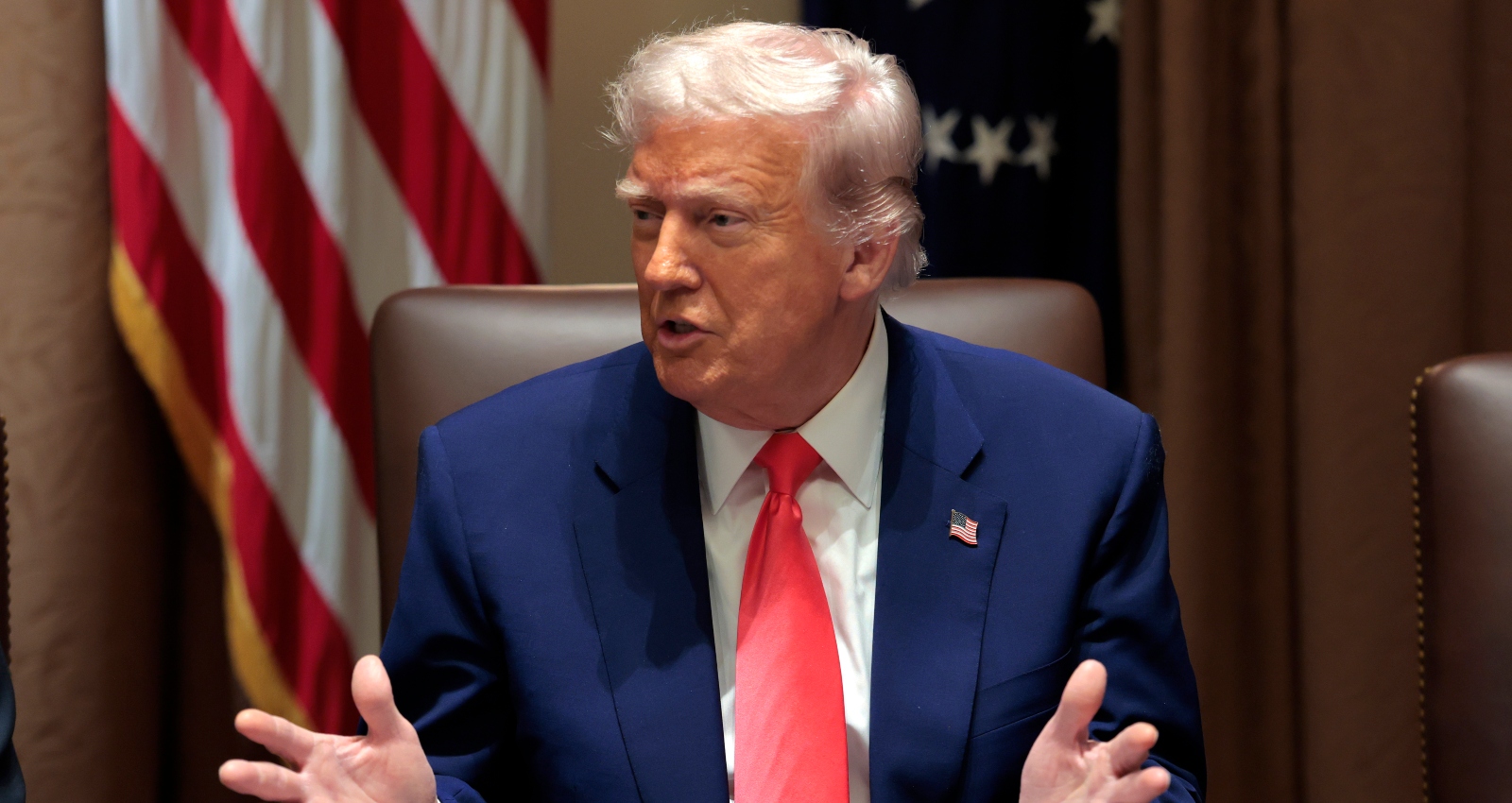
A plurality of registered voters supports President Donald Trump’s proposal to send $5,000 payments to adult U.S. citizens, according to a new Economist/YouGov survey, though voters remain skeptical that the plan will ultimately be carried out.
The survey asked respondents, “Would you favor or oppose the government in Washington sending $5,000 to every adult citizen in the U.S.?” Notably, Trump floated this dividend during his speeches at the Republican midterm in Dallas.
The poll found that 48% of respondents strongly or somewhat favored the federal government sending $5,000 to every adult citizen, while 40% opposed the idea.
Support varied significantly along party lines, with 61% of Republicans favoring the payments compared with 29% who opposed them. Among Democrats, 39% supported the proposal and 48% opposed it. Independents were more closely divided, with 41% in favor and 44% opposed.
The Economist/YouGov survey was conducted from Sept. 11 through Sept. 14 among 1,461 registered voters and had a margin of error of plus or minus 3.3 percentage points.
Trump unveiled the proposal during the Republican midterm convention in Dallas earlier this month, promising a $5,000 “Trump dividend” to adult U.S. citizens if Republicans maintain control of both the House and Senate in November’s midterm elections. Trump said the money would have to be spent in the United States.
The White House has promoted the proposal as a way of allowing Americans to share in the country’s economic gains. Trump has compared the concept to a successful corporation distributing profits to its shareholders.
Despite support for receiving the payments, the YouGov survey found substantial skepticism about whether Trump would actually be able to deliver them. Only 21% said they believed Trump definitely or probably would issue the payments if Republicans retained control of Congress, while 57% said they believed he probably or definitely would not.
Any such payment would face significant legislative and budgetary hurdles.
House Speaker Mike Johnson, R-La., has said congressional authorization would be necessary before the federal government could distribute the money. Johnson described the proposal as a “creative idea” but acknowledged that lawmakers would have to work through the details.
Providing $5,000 to roughly 240 million American adults would carry an estimated price tag of about $1.2 trillion, according to an analysis by Reuters. Trump and Vice President JD Vance have suggested tariff revenue could help finance the payments, but existing tariff collections would not be sufficient to cover the entire estimated cost. Without spending reductions or additional revenue, the payments could therefore increase the federal deficit.
Trump has disputed concerns about the price tag, saying the federal government could accommodate the payments because of increased revenue. “It’s easy to fit it into the budget,” Trump said during a trip to Ireland.
The proposal has received a mixed response on Capitol Hill, including among Republicans. Some GOP lawmakers have expressed concerns about the potential impact on the federal debt and inflation, while others have indicated they are willing to consider the idea if a workable funding mechanism can be developed. Democrats have criticized the proposal and questioned both its financing and its timing ahead of the midterm elections.
The United States has previously used large-scale direct payments as a form of economic relief. During the COVID-19 pandemic, Congress approved three rounds of stimulus payments totaling approximately $814 billion. Those payments were intended to provide immediate financial assistance during the economic disruption caused by the pandemic.
Trump also proposed a $2,000 tariff-funded dividend in 2025, but the idea was never enacted by Congress. His latest proposal is substantially larger and has become part of his economic message heading into the November elections.
For now, the Economist/YouGov findings show a distinction between voters’ views of the payment itself and their expectations about whether it will happen: more respondents favor the $5,000 payments than oppose them, while a majority remains doubtful that the promised dividend will ultimately be distributed.
This article may contain commentary which reflects the author's opinion.
