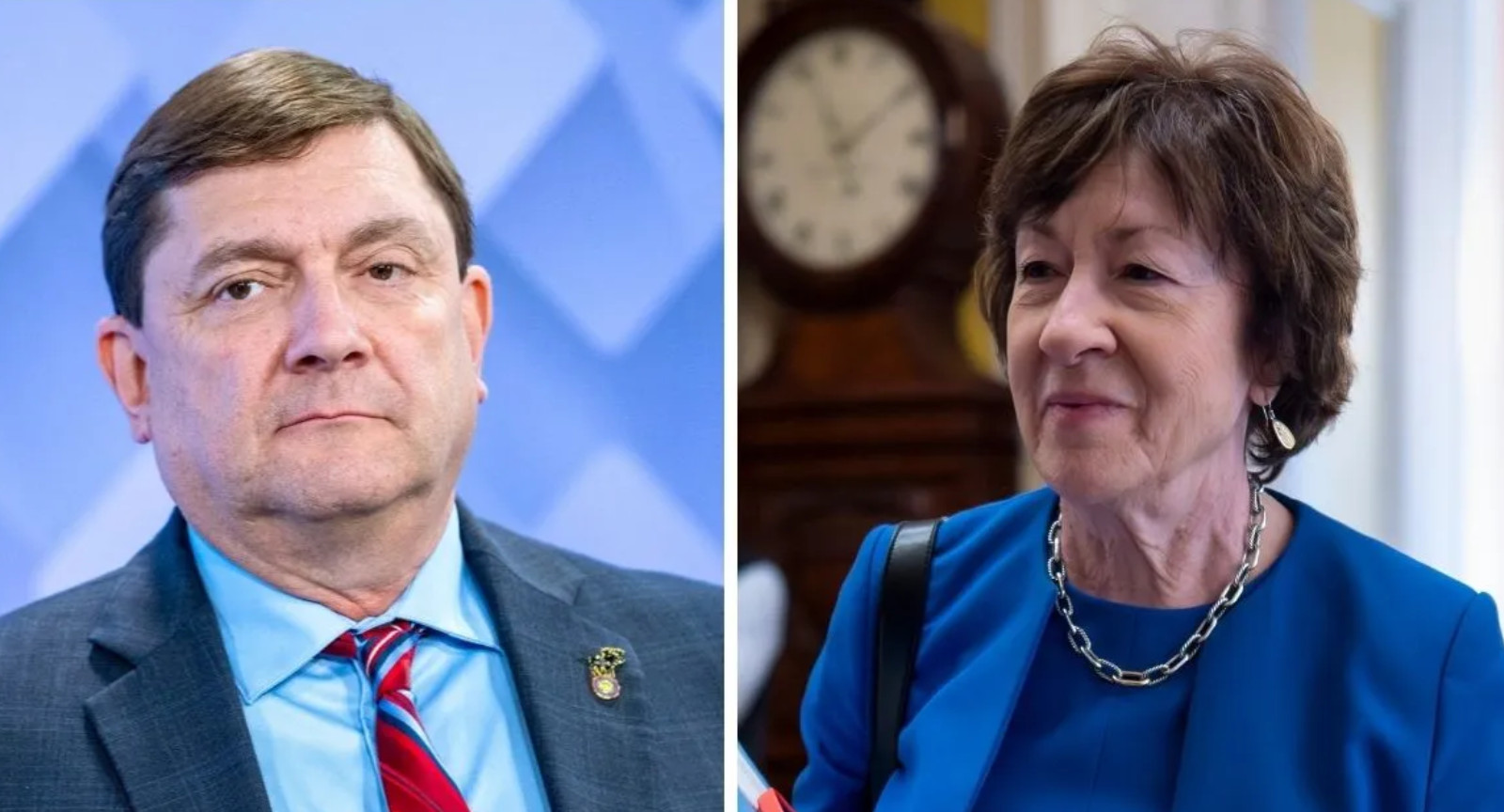
A major new Maine Senate poll has delivered Republican Sen. Susan Collins her strongest public showing of the fall campaign.
The New York Times, Siena Research Institute, and Portland Press Herald survey shows Collins leading Democrat Troy Jackson 49%-46%.
The survey questioned 619 likely Maine voters between September 15 and September 22, with five percent remaining undecided.
For Democrats, Maine matters because the party needs a net gain of four seats to capture U.S. Senate control this November.
Collins is seeking a sixth Senate term after first winning the election in 1996 and beginning her service in January 1997.
Jackson, a logger and former Maine Senate president, entered the contest after losing June’s Democratic gubernatorial primary to Hannah Pingree.
He replaced Graham Platner, who withdrew from the Senate contest in July following sexual-assault allegations that Platner publicly denied.
The new result represents a shift from prominent late-summer polling that had shown Jackson narrowly ahead of the Republican incumbent.
The Siena results show Collins drawing strength from voters who do not necessarily support Republicans nationally or President Donald Trump.
Maine reporting on the poll shows Collins and Jackson tied among independent voters at 47 percent each.
Collins also received support from eight percent of Democrats, while Jackson attracted three percent of Republicans in the survey.
Susan Collins leads Troy Jackson 49 percent to 46 percent in an independent poll, though Maine’s Senate race remains tight. https://t.co/fLViM9X5yu pic.twitter.com/XKArxSt5V1
— Newsweek (@Newsweek) September 24, 2026
Approximately twelve percent of voters who backed Kamala Harris in 2024 said they now planned to support Collins.
Those crossover voters illustrate Collins’ longstanding effort to cultivate an independent political identity inside an increasingly polarized national environment.
When asked about effectiveness, experience, federal resources, and support for American manufacturing, voters rated Collins substantially higher than Jackson.
Fifty-four percent said Collins would be the more effective senator, compared with 43 percent who selected Jackson.
Nearly 6-in-10 respondents believed Collins would bring more resources to Maine, while 35 percent gave Jackson the advantage.
On American manufacturing, Collins held a 52%-41% advantage, another area where her lengthy Senate tenure may shape voter perceptions.
Collins chairs the Senate Appropriations Committee, giving her campaign a concrete argument about seniority and delivering federal funding to Maine.
The campaign has become increasingly combative, with both sides running or promoting attacks concerning taxes, electricity costs, healthcare, and Trump.
Those findings show why Maine remains significant: Democrats need pickups while simultaneously defending competitive seats elsewhere across the national map.
Republicans are entering the final stretch of the 2026 midterm elections backed by a formidable financial operation, as President Donald Trump’s political network and national GOP committees pour money into critical House and Senate contests.
Trump said this month that his political war chest is approaching $1 billion and that he has allocated roughly $400 million to $500 million for the midterms, while also intending to preserve some resources for the 2028 cycle.
The centerpiece is MAGA Inc., the pro-Trump super PAC that accumulated more than $400 million by this summer, giving the president’s allies a large pool of money for a non-presidential election year.
That money is now moving rapidly.
Since September began, MAGA Inc. and other Trump-linked super PACs have invested more than $130 million in races nationwide through reserved advertising.
One vehicle is No Going Back PAC, a Trump-linked super PAC that has booked advertising across battleground Senate states, including Michigan, Ohio, North Carolina, New Hampshire, Alaska, and Georgia, while also targeting competitive House districts.
MAGA Inc. launched a $10 million advertising campaign supporting Republican Senate nominee Ken Paxton, while a Senate Leadership Fund-linked Texas PAC separately began an eight-figure campaign and planned continuous advertising through Election Day.
The Republican apparatus also enters the closing weeks with substantial resources.
New federal filings showed the Republican national party committees finished August with approximately $234 million in cash, about $100 million more than their Democratic counterparts.
Federal Election Commission records show the Republican National Committee reported approximately $125.6 million in cash on hand through August 31, after collecting roughly $316.3 million during the 2025-2026 cycle.
Senate Republicans are deploying money aggressively.
The National Republican Senatorial Committee allocated $46.5 million in coordinated spending across eight states, including $5.3 million in New Hampshire and $4.2 million in Michigan, Axios reported.
House Republicans are also taking advantage of new campaign-finance rules following a Supreme Court ruling that removed limits on coordinated party spending.
The National Republican Congressional Committee reserved nearly $9 million in coordinated television advertising across more than 20 House races during September, according to Axios.
The spending demonstrates how Republicans are using their financial advantage to defend vulnerable seats and compete for Democratic-held territory during the campaign’s final weeks.
“I’m going to spend whatever amount of money necessary to try and help us,” Trump said September 4, while adding that he expects money to remain available for 2028.
This article may contain commentary which reflects the author's opinion.
