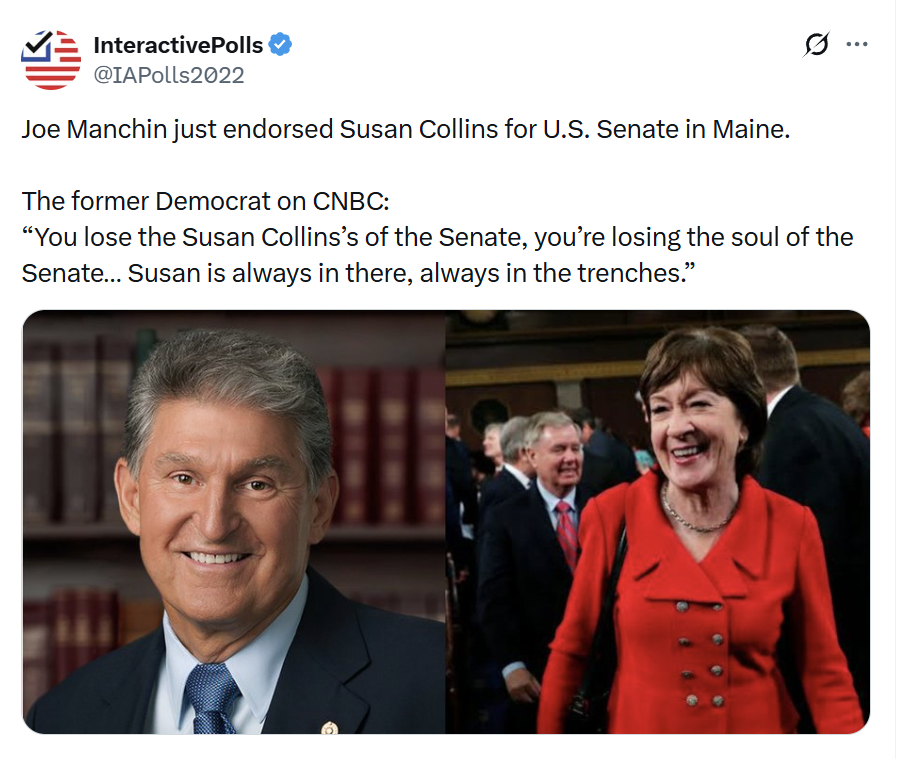
Former Democratic Sen. Joe Manchin has crossed party lines to endorse Republican Sen. Susan Collins in her reelection campaign, delivering a notable show of support as Maine prepares for one of the most closely watched Senate contests of the November midterms.
Manchin, the former West Virginia senator who left the Democratic Party to become an independent in 2024, praised Collins as an increasingly rare example of bipartisan leadership in Washington.
During an appearance on CNBC’s Squawk Box, Manchin said the Senate cannot afford to lose lawmakers willing to work across party lines.
“You lose the Susan Collinses of the Senate, you’re losing the soul of the Senate,” Manchin declared.
He described Collins as someone who consistently attempts to find practical solutions and maintain relationships with lawmakers from both parties.
Manchin also announced that he intends to campaign for Collins in Maine as she seeks a sixth term in the Senate.
“I’m gonna do everything I can to help,” he said.
Correction: Joe Manchin has the largest Democratic Senate WAR, at an impressive D+27.3
He’s not the strongest overall Democrat however, as he finishes second to the absolute chad Nathan Mathis’ THIRTY TWO POINT ONE PERCENT Wins Above Replacement rating
can’t tell ya why tbh https://t.co/V3rqPeYIi6 pic.twitter.com/EiEzMJmobX
— Pizzagamer888 (@RealPizzaGamer) September 30, 2026
The endorsement reflects a longstanding political relationship between two senators known for occasionally breaking with their respective parties.
Manchin and Collins worked together on several major bipartisan initiatives during their overlapping years in Congress.
Both participated in negotiations surrounding the 2021 infrastructure legislation, which provided federal funding for transportation, broadband and other infrastructure projects.
They also supported the Bipartisan Safer Communities Act in 2022, which expanded certain federal gun restrictions and provided funding for mental health programs and school safety.
The two lawmakers were involved in bipartisan negotiations that produced the Electoral Count Reform Act, legislation intended to clarify congressional procedures for certifying presidential election results.
That measure established that the vice president’s role in counting electoral votes is ceremonial and increased the number of lawmakers required to initiate objections to a state’s electoral votes.
Manchin and Collins also participated in the Common Sense Coalition, a bipartisan group that sought compromises during several contentious congressional debates.
Their working relationship helps explain why Manchin has chosen to support Collins despite their different party affiliations.
In fact, the former West Virginia senator also endorsed Collins during her 2020 reelection campaign.
Collins is running against former Maine Senate President Troy Jackson, who secured the Democratic nomination earlier this year.
The contest has attracted national attention because Democrats are attempting to gain control of the Senate while Republicans seek to maintain their majority.
Jackson has emphasized healthcare, economic inequality, workers’ rights and affordability during his campaign.
He has also criticized Collins over her record on abortion rights and her relationship with President Donald Trump.
Collins, meanwhile, has highlighted her seniority, legislative experience and willingness to oppose Republican leadership on selected issues.
During an October debate, she pointed to disagreements with Trump over tariffs, immigration enforcement and military policy.
She also reminded voters that she voted to convict Trump during his second impeachment trial following the January 6 Capitol riot.
Jackson has argued that Collins’ occasional disagreements with Trump do not outweigh her support for other Republican priorities.
The senator has defended her approach as an effort to evaluate legislation and administration policies individually rather than follow party leadership automatically.
Manchin’s endorsement comes as Republican leaders increasingly argue that the Democratic Party is moving further left.
House Speaker Mike Johnson recently warned that the growing influence of the Democratic Socialists of America could significantly change the party’s direction.
During a CNBC interview, Johnson argued that progressive activists are gaining influence over Democratic candidates and legislative priorities.
“The insurgent left is consuming the Democrat Party,” Johnson declared.
Those remarks reflected the speaker’s political assessment rather than an established consequence of Democratic electoral victories.
Democrats have disputed Republican characterizations of their party, and ideological differences remain substantial among Democratic candidates and elected officials.
The debate has nevertheless become an important part of the broader midterm campaign, particularly as candidates associated with democratic socialist organizations compete in state and federal elections.
This article may contain commentary which reflects the author's opinion.
