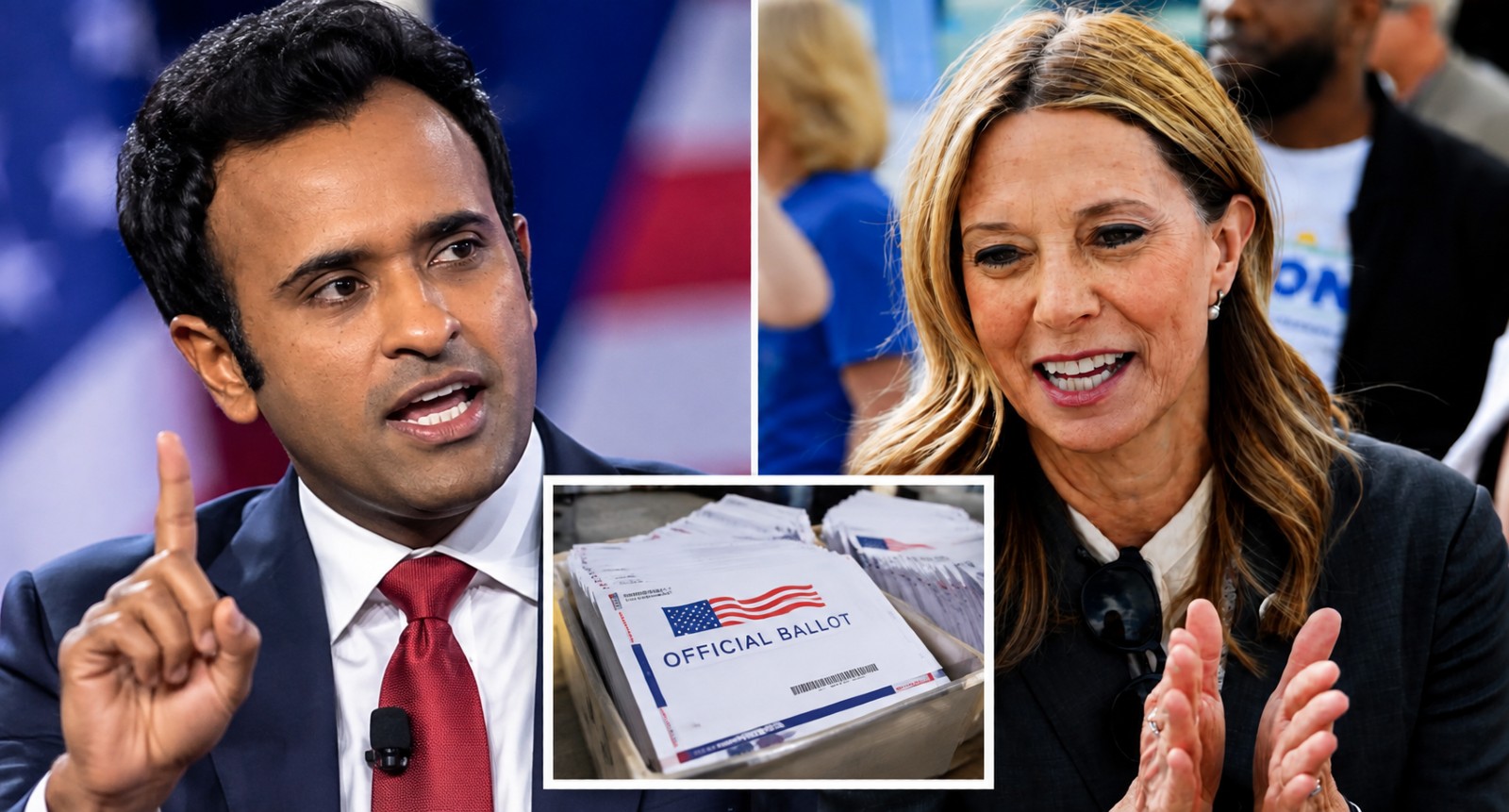
Early voting has opened in Ohio and, while still early, doesn’t look particularly promising for Democrats.
“It’s not gonna be quite presidential numbers, um, but I do think it will be stronger than last year,” Wood County Board of Elections Director Terry Burton said.
He said election officials can confirm how many people truly voted after election season wraps up, compared with years past.
“I think there’s going to be a really great turnout this year, and voters are going to be really engaged,” Warner said.
Election data expert, Latinx adjacent doctor, posted some of the early voting data on X in Ohio and said Democrats should be worried.
Hamilton County (Cincinnati Brown+41) had 2359 in person votes cast. Hamilton still has NOT uploaded their raw voter files from yesterday so I can’t check demographic date.
This was *well* below my “worst” for Dems expectation.
Same day in 2024: 3309 (-29%)
— Latinx Adjacent Doctor PhD (@TonerousHyus) October 7, 2026
Applying just a brute force model you expect 68k to vote IPEV in Hamilton vs 96k in 2024.
Could obv be lower if it acts like a normal midterm and last few week of IPEV isn’t strong like 2024 was. Early vote was 32% in 2018/2022 and 40% in 2024 of the total vote here.
— Latinx Adjacent Doctor PhD (@TonerousHyus) October 7, 2026
Given the mail drop from 2024 let’s just assume it’s 32% to give Dems a huge benefit of the doubt:
-38%*-30% (Skewed a bit towards mail) is -35%. So raw dog nailing 11.2% off the RAW turnout in 2024 without even assessing Election Day turnout (68.4-11.2% is 57%)
Ouuuuuch
— Latinx Adjacent Doctor PhD (@TonerousHyus) October 7, 2026
It’s not just Ohio, either.
Something is changing in Florida’s mail ballot returns, but the first numbers leave important questions unanswered.
Republicans often dominate on Election Day voting, while Democrats have always dominated early voting.
That trend is starting to change—and it’s good news for Republicans.
The movement involves three groups of voters, and one group accounts for the biggest shift.
Open Source Zone reported that Democrats account for 43.3 percent of Florida’s 2026 returned mail ballots, compared with 35.6 percent for Republicans.
Independents account for the remaining 21.1 percent in the breakdown posted Tuesday.
Compared with the 2024 election, the Democratic share rose 1.7 percentage points, while the Republican share rose 1.1 points.
The independent share fell 2.8 points, the largest change among the three groups.
Democrats lead Republicans by 7.7 points among the returned mail ballots in the post.
The stated changes imply 2024 shares of 41.6 percent for Democrats and 34.5 percent for Republicans.
They also imply that independents accounted for 23.9 percent of the 2024 comparison.
On that basis, the Democratic lead over Republicans was 7.1 points in 2024.
The lead in the posted 2026 returns is six-tenths of a point wider.
Both parties gained share, while independents lost enough share to account for those gains.
That is a measurable change in the makeup of the returns, though its significance remains unclear.
The post supplies percentages but does not say how many ballots have been returned.
Without ballot counts, a change in share cannot tell readers how many additional Democrats or Republicans returned ballots.
It also cannot show whether either party has more returned ballots than at a comparable point in 2024.
The post does not specify when its return figures were collected or last updated.
That detail matters because the percentages can change as more ballots arrive.
It also does not explain whether its 2024 comparison measures returns from a similar point in the election.
A comparison with all 2024 returns would mean something different from a comparison with returns at the same stage.
Publishing the dates and ballot totals would let readers judge the shift more clearly.
The reported percentages describe voters’ registration, not their choices in any particular race.
A registered Democrat can vote for a Republican candidate, and a registered Republican can vote for a Democrat.
Independent voters’ candidate choices are likewise unknown from these return figures.
The breakdown therefore cannot establish who is winning an election.
The 2.8-point drop deserves attention because it is larger than either party’s individual gain.
2026 Florida Mail Ballot Returns 🔵 43.3% (+1.7) 🔴 35.6% (+1.1) 🟡 21.1% (-2.8) (+/- vs 2024 Election) https://t.co/S7XIszuGho
— OSZ (@OpenSourceZone) October 6, 2026
It does not, by itself, explain why independents make up a smaller share of reported returns.
Some voters may return ballots later, but the post provides no information about their plans.
Nor can the percentages reveal whether differences in ballot-return timing produced the shift.
For now, the numbers support a narrow conclusion about the composition of ballots already returned.
Democrats hold the largest share at 43.3 percent, followed by Republicans at 35.6 percent.
Independents account for just over one-fifth of the posted returns.
This article may contain commentary which reflects the author's opinion.
