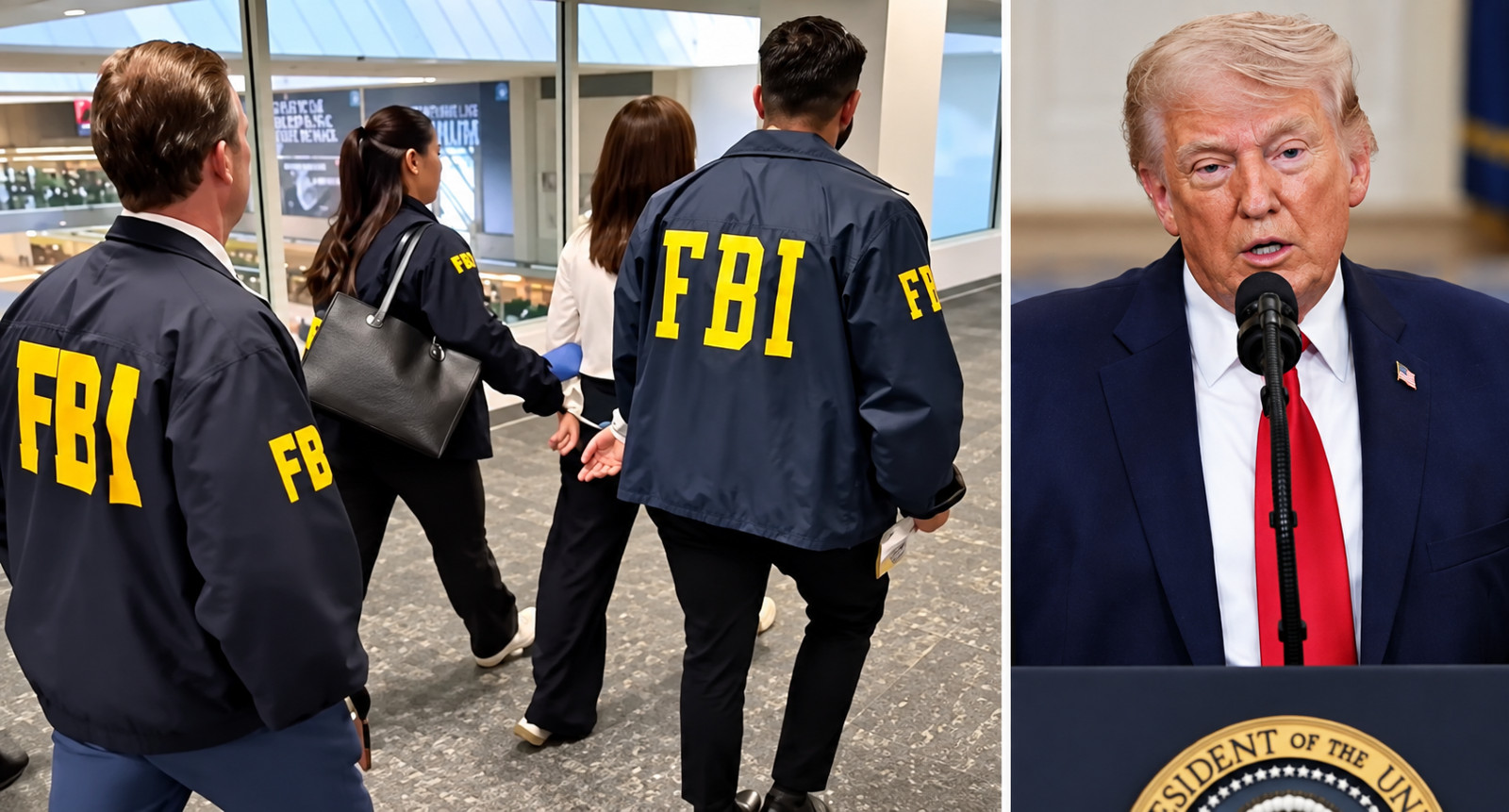
Federal agents arrested a California realtor at LAX Sunday, accusing her of secretly conducting surveillance inside America for Communist China.
Wanying “Heather” Zhang, 34, of Irvine, was preparing to board a flight to Shanghai when FBI agents moved in.
Federal prosecutors charged Zhang with acting as an unregistered agent of the People’s Republic of China, allegations she has not admitted.
Authorities say Zhang targeted the family of Taiwanese President Lai Ching-te during an alleged covert surveillance operation in Washington state.
Her principal target was reportedly Lai’s adult son, Ting-Yu Lai, who lives and works in the Seattle area.
The case immediately intensified concerns about Beijing allegedly conducting foreign intelligence and influence operations on American soil.
“We just arrested a Chinese foreign agent at LAX attempting to depart for China,” federal prosecutor Bill Essayli announced Sunday.
According to the criminal complaint, Zhang traveled to Seattle during September 2025 while allegedly taking instructions from Chinese government contacts.
Investigators accuse her of collecting photographs, video recordings and license-plate information concerning Lai’s son and his relatives.
Zhang allegedly transmitted that information to Chinese officials while communicating through WeChat, according to federal investigators.
Federal authorities obtained communications from Zhang’s iCloud account that allegedly documented contact with two people investigators identified as Chinese officials.
Those communications reportedly stretch back to September 2022 and covered children, investments and differences between China and America.
California realtor, 34, busted at LAX for spying for China as creepy texts to Beijing handlers revealed: feds https://t.co/SPCawsg2ed https://t.co/0OHIMJ7OWM
— New York Post (@nypost) October 5, 2026
By 2025, however, investigators allege Zhang’s communications developed into discussions eventually connected with surveillance of Lai’s family.
In March 2025, Zhang allegedly told one contact she intended to visit Beijing and suggested meeting there.
“I will go to Beijing. Let’s organize a small gathering. Ha,” Zhang allegedly wrote.
Communications continued through June, including discussions about Zhang potentially meeting an alleged Chinese official while inside the United States.
The final messages preceding the Seattle surveillance allegedly occurred during August 2025, according to the federal complaint.
Zhang then traveled north the following month and allegedly began monitoring the Taiwanese president’s son around his Seattle-area residence.
During one September exchange, Zhang allegedly notified a Chinese government contact that she had spotted Lai’s son.
“It’s that young one,” Zhang allegedly wrote while conducting the surveillance operation described by investigators.
The official allegedly asked Zhang whether she was available for an audio call while she remained near the residence.
Zhang reportedly responded that she was recording video of Lai instead, according to communications cited in the complaint.
Investigators say Zhang worked alongside an associate while photographing and recording the family outside their home.
Surveillance-camera images allegedly captured Zhang inside a vehicle with that associate while monitoring the residence, federal authorities said.
One image allegedly shows Zhang reclining her seat while taking photographs, behavior investigators portrayed as an attempt to avoid detection.
Authorities say Zhang sent photographs of the residence and additional identifying information directly to her alleged Chinese government contacts.
Essayli said Zhang “used tradecraft to avoid detection” while allegedly carrying out the surveillance mission.
“She never notified the Attorney General she was acting for a foreign government, a federal offense,” Essayli said.
Federal law requires people acting inside America as agents of foreign governments to provide notification to the attorney general.
Prosecutors allege Zhang never made that required disclosure despite taking direction from officials connected to Beijing.
Essayli later described the case as part of a broader problem involving Chinese government activity inside California.
“We have a problem with Beijing using Chinese-Americans for their own purposes in California,” Essayli said.
“They are using them for their own foreign affairs because they are playing the long game,” he continued.
Essayli said Beijing allegedly seeks “to get a competitive advantage over us” through activities involving people inside America.
“She wasn’t spying against us, she was allegedly conducting a campaign on behalf of Beijing,” Essayli emphasized.
Zhang worked as a Southern California real estate agent and reportedly worked at the same firm as her husband.
Her husband, Edric Ding, told CBS News on Sunday that he lacked information concerning his wife’s arrest.
“I don’t know anything yet,” Ding said before declining further comment.
Zhang’s nationality was not immediately clear, and authorities initially provided no public information identifying her defense attorney.
She was scheduled to make her initial appearance Monday in federal court in Los Angeles.
Taiwan’s government responded forcefully after American authorities disclosed the alleged operation targeting President Lai’s relatives.
Taiwan’s Presidential Office confirmed relatives of Lai were targeted while condemning the alleged conduct attributed to Beijing.
Officials called the alleged surveillance “a classic case of transnational repression” occurring beyond China’s borders.
Taiwanese officials said such activities violate individual rights while threatening the sovereignty and security of democratic nations.
The presidential office also thanked American authorities for investigating the alleged operation and protecting Taiwanese citizens inside the United States.
China considers democratically governed Taiwan part of Chinese territory and has refused to renounce force for achieving unification.
Taiwan rejects Beijing’s sovereignty claims, while Lai maintains Taiwan’s future should be determined exclusively by its people.
Beijing has repeatedly branded Lai a separatist while criticizing his government’s defense policies and resistance to Chinese sovereignty claims.
The Chinese government said Monday it was unfamiliar with Zhang’s case while objecting broadly to accusations involving Chinese espionage.
The arrest comes amid heightened American concern regarding alleged Chinese intelligence, influence and transnational-repression operations throughout the United States.
Earlier cases have involved accusations of covert Chinese police stations, political influence efforts and surveillance targeting Beijing’s overseas critics.
Southern California has become a particular focus following several federal investigations involving alleged activities benefiting Chinese government interests.
Zhang’s case remains at the accusation stage, meaning prosecutors must prove their allegations and she retains the presumption of innocence.
Still, the complaint presents an extraordinary allegation: an American-based realtor secretly monitoring a democratic leader’s family for Communist China.
The FBI’s airport arrest prevented Zhang from departing for Shanghai while placing another alleged Beijing operation under intense national scrutiny.
This article may contain commentary which reflects the author's opinion.
