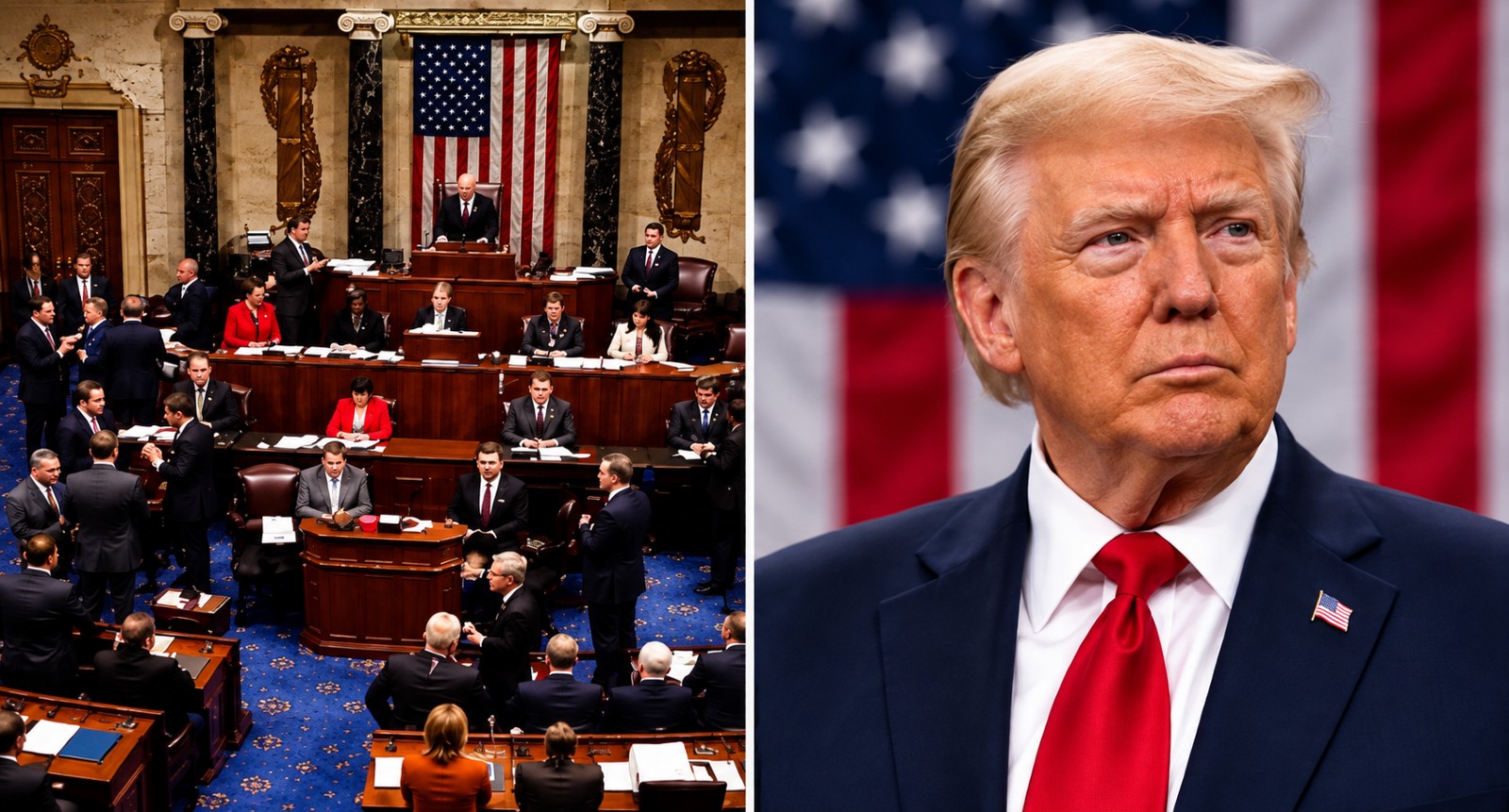
With voters already casting ballots for November’s midterm elections, pressure is building within the Republican Party to advance more of President Donald Trump’s legislative agenda.
One Republican senator is publicly urging Senate leadership to act more quickly, arguing that there is little time left to deliver on several key priorities before lawmakers leave Washington for the campaign season.
Utah Republican Sen. Mike Lee renewed his call for Congress to pass the SAVE America Act after a Reuters investigation revealed that over 30,000 self-declared noncitizens were added to U.S. voter rolls across 11 states since 2000.
The report cited software glitches and clerical errors, which were often linked to automated vehicle registration.
While the investigation noted it was unclear how many actually voted, recent state data from New Jersey showed fewer than 400 ballots cast among 6,600 mistakenly registered noncitizens.
Speaking on the Senate floor on Thursday, Lee argued that existing bans on noncitizen voting are virtually impossible to enforce because systems rely on an “honor system” of self-attestation.
“It should not be any easier for someone to get away with voter fraud at a polling location… than it is to cheat Olive Garden through its never-ending pasta pass,” Lee said.
The House-passed SAVE America Act, backed by President Trump, would require voters to present documentary proof of citizenship to register, but the bill remains stalled in the Senate amid debate over whether strict requirements could inadvertently disenfranchise eligible citizens.
Republicans have 50 votes, but it would require 60 to pass in the U.S. Senate.
Vice President JD Vance says the Trump administration has explored an unusual Senate procedural maneuver that could help advance the SAVE America Act but acknowledged that a small group of Republican senators remains an obstacle.
Speaking on Newsmax’s “Carl Higbie FRONTLINE” recently, Vance said the White House has examined whether he could use his constitutional position as president of the Senate to preside over the chamber and issue a ruling contrary to the advice of the Senate parliamentarian.
“So, we’ve actually looked into this. As the president of the Senate under the U.S. Constitution, there are things that we can do,” Vance said.
“We can take over the Senate chair. I can occupy the chair. We can overrule the parliamentarian. Those things are very possible.”
The parliamentarian advises the Senate’s presiding officer on the chamber’s rules and precedents but does not issue binding rulings on its own.
The presiding officer generally follows that advice when ruling on procedural questions. Senators can then appeal many of the chair’s rulings, allowing the full Senate to decide whether the decision should stand.
Depending on the procedural question involved, a simple majority often decides such appeals, although certain budget-related points of order require a higher threshold.
Vance said the administration’s problem is determining whether enough Republican senators would support such a move.
“The fundamental issue with that is not the 60-vote threshold. It’s the 50-vote threshold,” Vance said. “So if, for example, I took over the Senate chair, and I overruled the parliamentarian, we would need to sustain 50 senators plus me.”
Vance said President Donald Trump, White House officials, and congressional Republicans have been discussing whether they could assemble sufficient support.
“Obviously, most Republicans would support it,” Vance said. “But could we get 50? That’s the big question.”
Republicans currently control the Senate, but the SAVE America Act has repeatedly encountered procedural obstacles because most legislation remains subject to the chamber’s 60-vote threshold for ending a filibuster.
The House passed the legislation 218-213 on Feb. 11, with nearly all Republicans supporting it and all but one Democrat opposing it.
The measure would require applicants registering to vote in federal elections to provide documentary proof of U.S. citizenship.
It would also establish a federal photo-identification requirement for voting and direct states to take additional steps to identify and remove noncitizens from their voter rolls.
Supporters argue that the requirements would strengthen election safeguards and public confidence in federal elections.
Republicans have considered several ways of advancing the bill without obtaining 60 votes.
This article may contain commentary which reflects the author's opinion.
