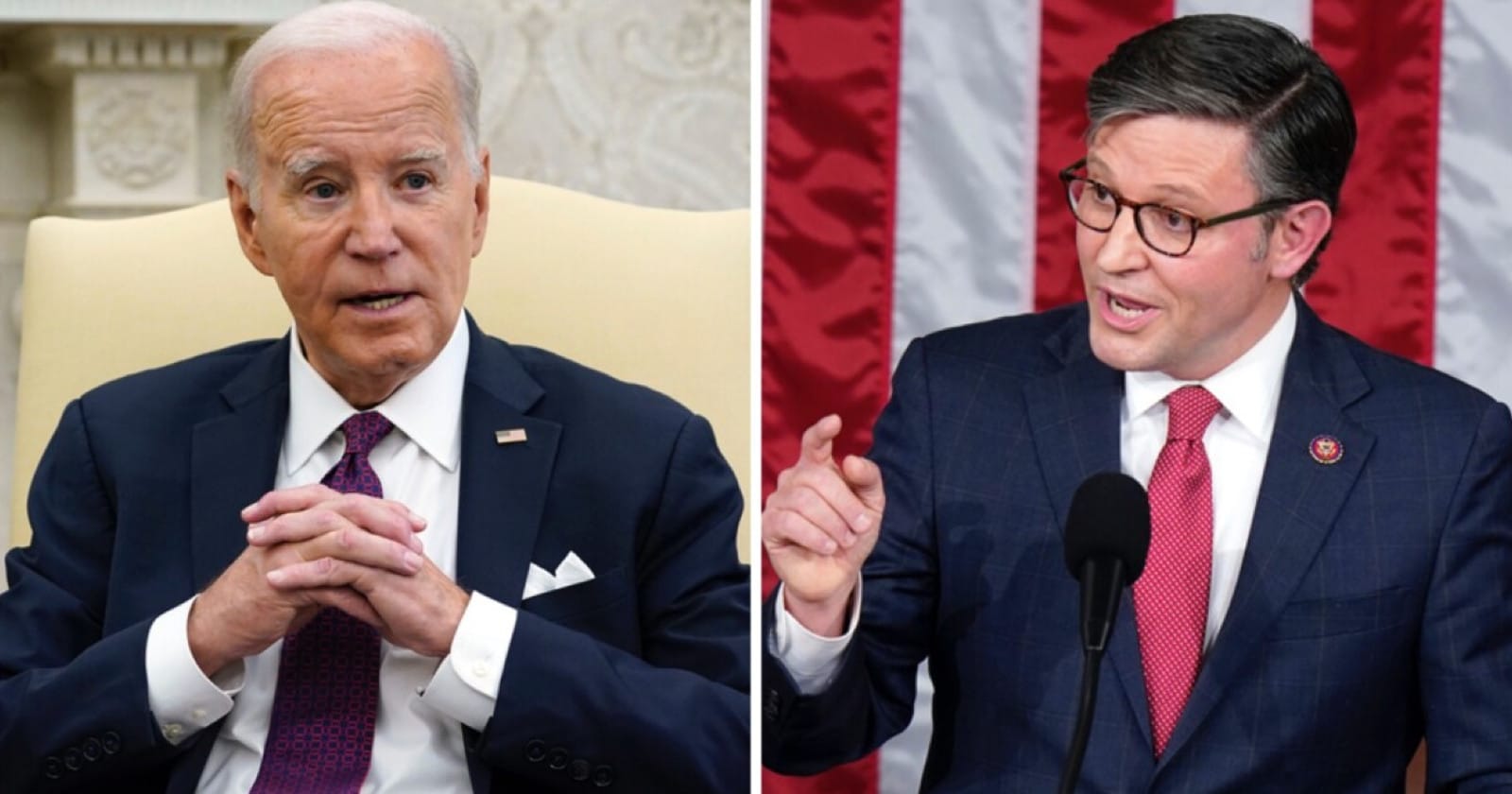
Newly crowned House Speaker Mike Johnson has already been a thorn in the side of President Joe Biden.
Legislation that would ban future electric vehicle (EV) mandates and strike down pending federal regulations targeting gas-powered vehicles is expected to be put to a vote on the House floor this week.
Representatives Tim Walberg (R-Michigan) and Andrew Clyde (R-Ga.), who introduced the Choice in Automobile Retail Sales (CARS) Act during the summer, will have their day in the House Rules Committee on Monday. Then, on Tuesday, the bill could be officially brought to the floor for a vote. Following its passage, the measure would go to the Senate for a vote; Senator Joe Manchin (D-WV) and his Republican colleagues have introduced similar legislation.
“The House must pass the Choice in Automobile Retail Sales Act to block a radical and unattainable federal EV mandate that will cripple our auto industry and forever make our supply chain reliant on China,” Walberg told Fox News Digital on Monday. “The American auto industry is at its best when it is free to innovate and listen to the will of consumers, not constrained by bureaucracy.”
“If this mandate goes into effect, many American families will be priced out of the market, and we will cede leadership of this industry to China,” he continued. “Instead, we must prioritize affordability, innovation, and freedom for each family to decide what car is best for them.”
Walberg, Clyde, and over a dozen other Republicans in the House introduced the bill months after the EPA proposed its most aggressive tailpipe emissions ever. The White House predicted that by 2032, with the rule finalized, electric vehicles could account for an astounding 67% of new sedan, crossover, SUV, and light truck purchases; up to 50% of buses and garbage trucks; 35% of short-haul freight tractors; and 25% of long-haul freight tractors, Fox News noted.
Part of the Biden administration’s larger effort to combat climate change by reducing carbon emissions and increasing the adoption of electric vehicles in the United States, the EPA regulations would be blocked if the CARS Act were to be put into effect.
The CARS Act would do more than just stop the planned regulations on tailpipe emissions; it would also make it illegal to impose rules that restrict the availability of new cars depending on the type of engine they have. Furthermore, the bill would mandate that the EPA revise any rules that impose engine-type restrictions on new cars no later than two years from the date of enactment.
“Aggressive, EV-only mandates take away consumer choice, stifle investment in alternate emission reduction opportunities, and benefit foreign adversaries like China with substantially more emission-intensive manufacturing than the United States,” Heather Reams, the president of Citizens for Responsible Energy Solutions, a right-leaning environmental nonprofit, told Fox News Digital.
“CRES is proud to support Rep. Walberg’s CARS Act because it prohibits the Biden administration from imposing aggressive and unrealistic emissions standards on American consumers, so we can apply an all-of-the-above approach to the transportation sector and reward emission abatement instead of EV purchases,” Reams said.
Republican lawmakers and energy analysts have been critical of the Biden administration’s proposed regulations to reduce tailpipe emissions since they would affect vehicles manufactured between 2027 and 2032. Electric vehicles, they say, are more expensive, inefficient, and reliant on Chinese supply chains than regular gas-powered vehicles.
As of July 2023, the average price of a gas-powered vehicle was $48,334 and the average price of an electric car was $53,469 (after accounting for generous tax credits), according to data from Cox Automotive. Also, in 2021, electric vehicles had a median range of 234 miles, while gas-powered vehicles had an average range of 403 miles, according to the Department of Energy.
Along with the EPA’s tailpipe regulations, the Biden administration pursued several other measures aimed at gas-powered vehicles. Automobile manufacturers have previously expressed concern that the National Highway Traffic Safety Administration’s (NHTSA) proposed strict fuel economy standards could result in billion-dollar fines that would then fall on consumers.
The American Petroleum Institute and the American Fuel and Petrochemical Manufacturers are among the energy industry groups that have endorsed the CARS Act.
This article may contain commentary which reflects the author's opinion.
