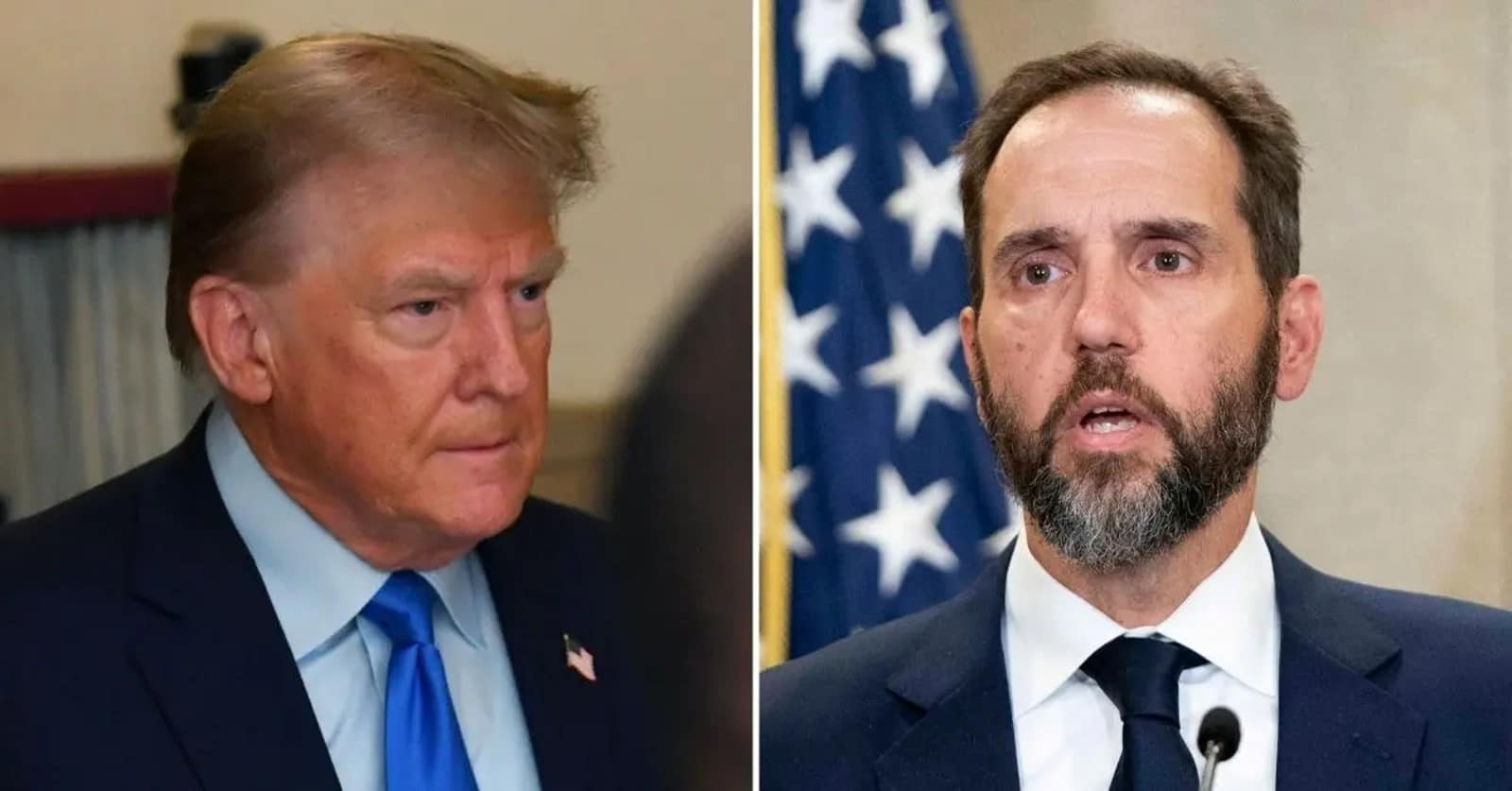
The acting head of the Justice Department has fired more than a dozen officials and career attorneys who worked with former special counsel Jack Smith to charge and attempt to prosecute President Donald Trump for more than a year leading up to his November election victory over Vice President Kamala Harris.
Fox News Digital first reported that Acting Attorney General James McHenry wrote letters to the prosecutors stating that he was letting them go because they could not be trusted to ” faithfully implement the president’s agenda. “
A DOJ official told Fox that McHenry transmitted a letter via email to each of the individuals.
Regarding the trust issue, one network legal analyst said during a show segment on Tuesday that every prosecutor who works with a special counsel does so on a voluntary basis—no one is assigned the task.
As such, prosecutors working with a special counsel generally have a personal interest in seeing the targeted individual(s) convicted. The implication is that the prosecutors McHenry dismissed were not fans of Trump and, therefore, he did not feel they could not be relied upon to faithfully execute their duties under his executive leadership.
Fox said it’s not clear how many DOJ prosecutors and officials were terminated, as a list of names was not immediately released.
“Today, Acting Attorney General James McHenry terminated the employment of a number of DOJ officials who played a significant role in prosecuting President Trump,” a DOJ official told Fox News. “In light of their actions, the Acting Attorney General does not trust these officials to assist in faithfully implementing the President’s agenda.”
This action “is consistent with the mission of ending the weaponization of government,” the official told Fox News Digital.
The decision follows the Justice Department’s reassignment of more than a dozen officials during the first week of the Trump administration to a Sanctuary City task force and other initiatives. It also aligns with President Trump’s commitment to ending the perceived weaponization of the federal government.
Former Attorney General Merrick Garland appointed Jack Smith, a longtime Justice Department official, as special counsel in November 2022.
Smith, a former assistant U.S. attorney and chief of the DOJ’s public integrity section, led the investigation into President Trump’s handling of classified documents after leaving the White House and whether he obstructed the federal government’s probe into the matter.
Smith was also assigned to oversee the investigation into whether President Trump or other officials and entities attempted to interfere with the peaceful transfer of power following the 2020 presidential election, including the certification of the Electoral College vote on January 6, 2021.
Smith brought charges against Trump in both cases, but Trump pleaded not guilty.
In July 2024, U.S. District Court Judge Aileen Cannon of the Southern District of Florida dismissed the classified records case, ruling that Jack Smith was unlawfully appointed as special counsel.
Smith had also indicted Trump in the U.S. District Court for Washington, D.C., over the 2020 election case. However, after Trump was elected president, Smith moved to dismiss the case, a request that Judge Tanya Chutkan granted.
Meanwhile, a federal judge on Monday reversed his order prohibiting Oath Keepers founder Stewart Rhodes and seven other members of the group from entering Washington, D.C., without court approval, following Trump’s commutation of their sentences for their involvement in the January 6, 2021, Capitol riot.
U.S. District Judge Amit Mehta, an Obama appointee who presided over the Oath Keepers conspiracy trials, vacated the restriction, stating that it would be “improper” to alter their original sentences “post-commutation.”
“It is not for this court to divine why President Trump commuted Defendants’ sentences, or to assess whether it was sensible to do so,” Mehta wrote, denying the Justice Department’s request to “dismiss” the Oath Keepers’ supervised release terms altogether but did acknowledge that, after the commutations, they will not be enforced. “The court’s sole task is to determine the act’s effect,” he said.
“The U.S. Department of Justice’s motion is granted in part and denied in part,” Mehta added. “The court will not ‘dismiss’ the non-custodial portion of defendants’ sentences, but defendants are no longer bound by the judicially imposed conditions of supervised release.”
This article may contain commentary which reflects the author's opinion.
