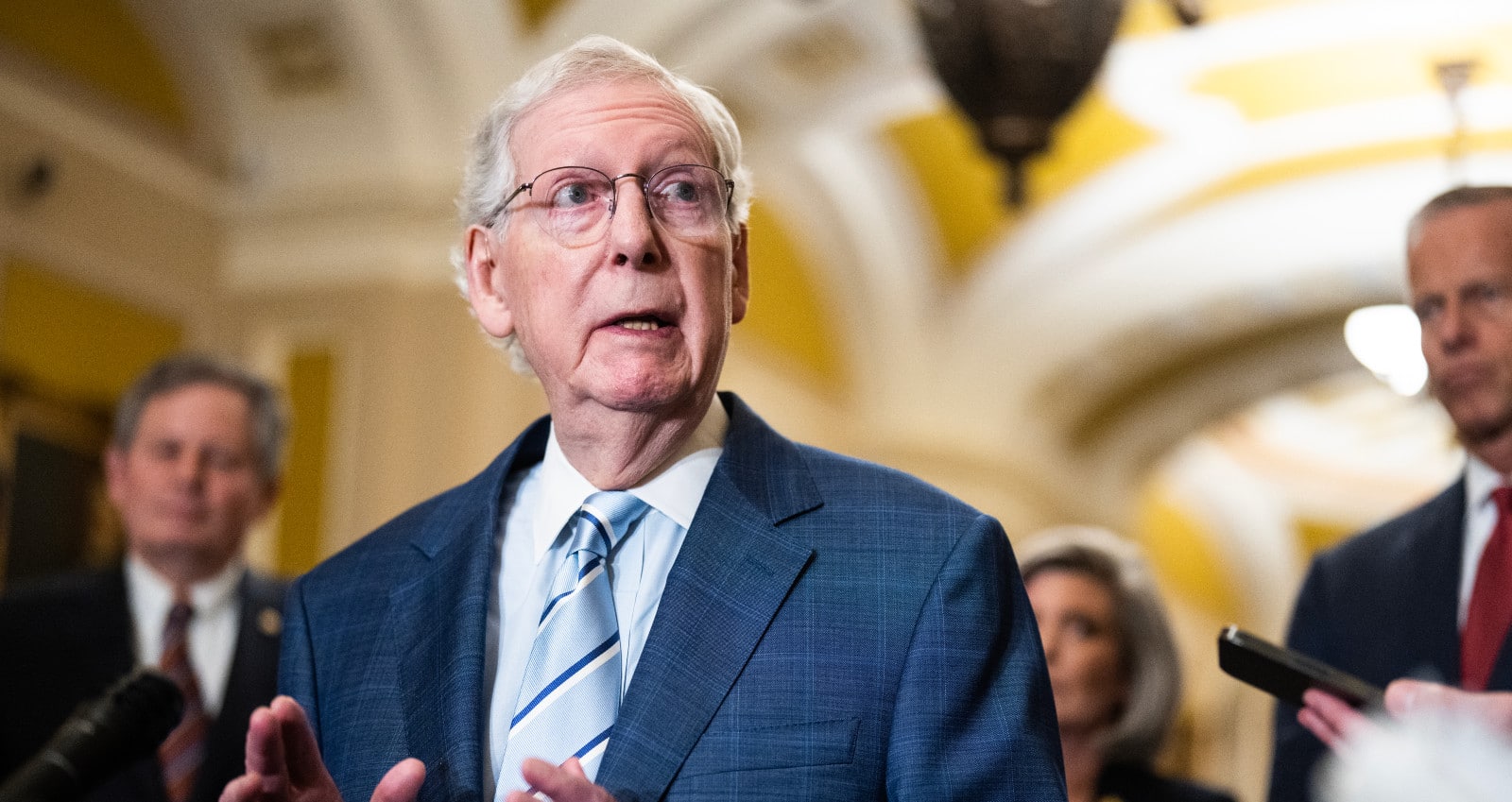
Senate Minority Leader Mitch McConnell, R-Ky., issued a rare public critique of President-elect Donald Trump and other GOP lawmakers in an op-ed published in Foreign Affairs.
McConnell pushed back against the growing embrace of what he sees as geopolitical isolationism within the party, specifically criticizing the incoming administration’s apparent foreign policy positions on Ukraine and America’s role in NATO, though Trump and his supporters claim their opposition is to endless foreign wars where the U.S. has no significant national security interests.
McConnell also criticized the Biden administration’s foreign policy approach and wrote that Trump will “inherit a world far more hostile to U.S. interests than the one he left behind four years ago.”
The former Senate GOP leader also claimed that “the response to four years of weakness must not be four years of isolation,” as he criticizes the “right-wing flirtation with isolation and decline.”
He criticized calls from within his party to “give up on American primacy,” and, in what appeared to be a direct message to the President-elect.
“The [Trump] administration will face calls from within the Republican Party to give up on American primacy,” McConnell wrote. “It must reject them. To pretend that the United States can focus on just one threat at a time, that its credibility is divisible, or that it can afford to shrug off faraway chaos as irrelevant is to ignore its global interests and its adversaries’ global designs. America will not be made great again by those who simply want to manage its decline.”
The op-ed calls on Trump to embrace what he describes as the U.S.’s “hard power” by, once again, boosting defense spending while also calling on the president-elect on him to stand up to China—who McConnell argued has “intensified its efforts to expand its military, political, and economic influence worldwide.”
He also called on Trump not to ‘abandon’ Ukraine, arguing that doing so would “also compound the threats from China, Iran, and North Korea.”
McConnell urged President-elect Trump to reaffirm his commitment to NATO. He highlighted that many alliance members have significantly increased their defense spending, a key demand Trump made during his first term. McConnell noted that more than two-thirds of NATO members now meet or exceed the target of allocating at least 2% of their GDP to defense.
For the record, Trump was tougher on China than any president before him in modern history, imposing tariffs and moving to eliminate other Chinese influences from within the country. Secondly, a majority of Americans are not interested in providing endless, unconditional financial and military support to Ukraine, no matter how hard the DC establishment—which includes McConnell—pushes for it.
Also, Trump has never rejected NATO but instead has called out members of the alliance for refusing to uphold their agreement to spend at least 2 percent of their GDP on their respective militaries, noting that the U.S. taxpayer has had to pony up the majority of support in order to keep the alliance viable.
Lastly, the Pentagon has never passed an audit, leading many Americans to call for better accounting for the hundreds of billions of taxpayer dollars that are provided to the Defense Department annually.
McConnell’s remarks, which advocate for an interventionist foreign policy similar to the George W. Bush administration and a larger defense budget to deter multiple adversaries, raise questions about how far the Kentucky Republican is willing to go in opposing the president-elect’s nominees and agenda.
Trump has pledged to end the Russia-Ukraine war and has criticized President Joe Biden for escalating tensions with Russian President Vladimir Putin during the final months of his presidency. On the campaign trail, Trump vowed to end the war before he took office, but that was before Biden authorized striking Russian soil with U.S.-made and supplied weapons and other acts of escalation.
This article may contain commentary which reflects the author's opinion.
