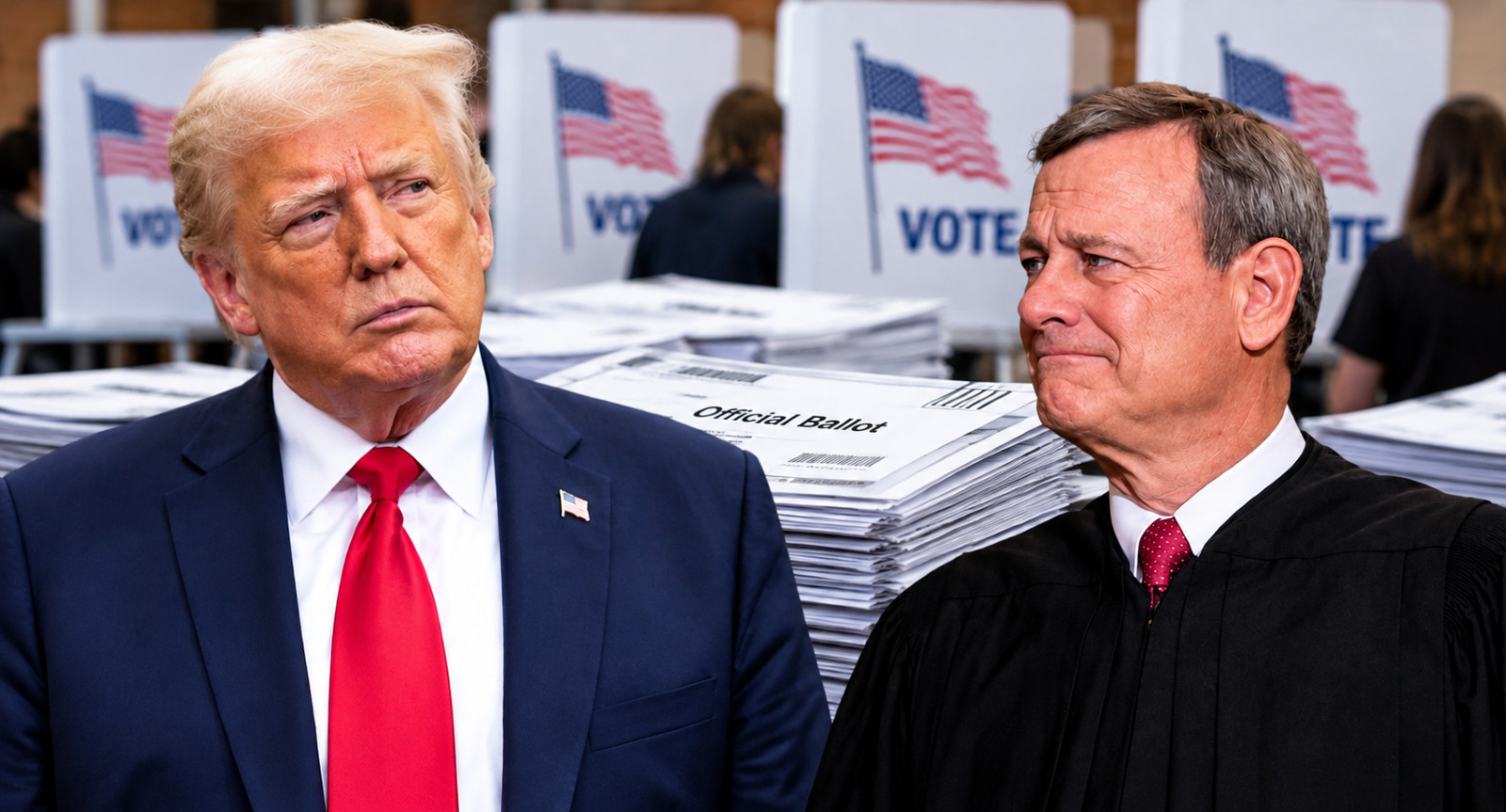
The U.S. Supreme Court has temporarily blocked a federal appeals court order requiring the Federal Communications Commission to resolve a dispute over discounted political advertising rates, allowing existing rules to remain in place as the November midterm elections approach.
Chief Justice John Roberts issued an administrative stay last week, suspending a lower court’s directive that would have forced the FCC to act by noon Friday and handing the Trump administration a win.
The dispute involves whether political party committees and joint fundraising organizations should receive the same discounted television and radio advertising rates guaranteed to individual political candidates under federal law.
The case has significant implications for both parties as they compete for control of Congress in the November 3 elections.
The Supreme Court’s intervention does not settle the underlying legal dispute. Instead, it temporarily prevents the FCC from being forced to issue an immediate decision while the justices consider additional arguments.
The controversy intensified Wednesday when the U.S. Court of Appeals for the Fourth Circuit ordered the FCC to resolve a pending challenge to its political advertising policy within approximately 48 hours.
The appeals court issued its order in a 2-1 decision after concluding that the agency had taken too long to address objections raised by four Democratic congressional candidates.
The judges criticized the FCC’s handling of the matter and questioned whether the delays were preventing meaningful judicial review before Election Day.
The majority declared that its willingness to tolerate the agency’s delays had ended.
The FCC, joined by two national Republican campaign committees, immediately sought emergency relief from the Supreme Court.
Federal officials argued that the appeals court’s deadline was unreasonable and would interfere with the commission’s administrative review process.
Roberts granted a temporary stay, allowing the FCC additional time while the Supreme Court considers whether to intervene more extensively.
The chief justice also directed the Democratic challengers to respond to the emergency application.
Federal law requires television and radio broadcasters to provide qualified political candidates with favorable advertising rates during specified periods before elections.
Known as the “lowest unit charge” requirement, the provision applies during the 45 days preceding a primary election and the 60 days preceding a general election.
The rule generally prevents broadcasters from charging eligible candidates more than the lowest rate available for comparable advertising time.
Congress established the requirement to help political candidates communicate with voters without facing the higher advertising costs that can accompany major election campaigns.
In March, the FCC’s Media Bureau issued guidance stating that certain political party advertisements and authorized joint fundraising committees could also qualify for the discounted rates.
The policy covers qualifying advertisements coordinated between political parties and candidates, as well as certain advertising purchases involving authorized fundraising committees.
Four Democratic candidates challenged that interpretation, arguing that the law reserves the benefit for legally qualified candidates rather than extending it broadly to political organizations.
The FCC maintains that its guidance reflects existing law and longstanding regulatory practices.
The legal challenge was brought by Democratic Senate candidates Sherrod Brown of Ohio, Jon Ossoff of Georgia and Roy Cooper of North Carolina, along with Michigan Democratic Rep. Kristen McDonald Rivet.
The candidates argue that expanding access to discounted advertising rates could undermine the special protections Congress established for individual campaigns.
Their challenge also raises questions about whether the FCC’s Media Bureau exceeded its authority when issuing the March guidance.
The candidates initially asked the commission to reconsider the policy in April.
When the agency did not issue a final ruling, the dispute moved into federal court.
In August, a divided Fourth Circuit panel sided with the Democratic candidates and invalidated the FCC guidance.
However, the Supreme Court intervened in September, issuing an 8-1 order that temporarily restored the policy.
The justices concluded that the challengers generally needed to obtain a final decision from the FCC before pursuing judicial review.
This article may contain commentary which reflects the author's opinion.
