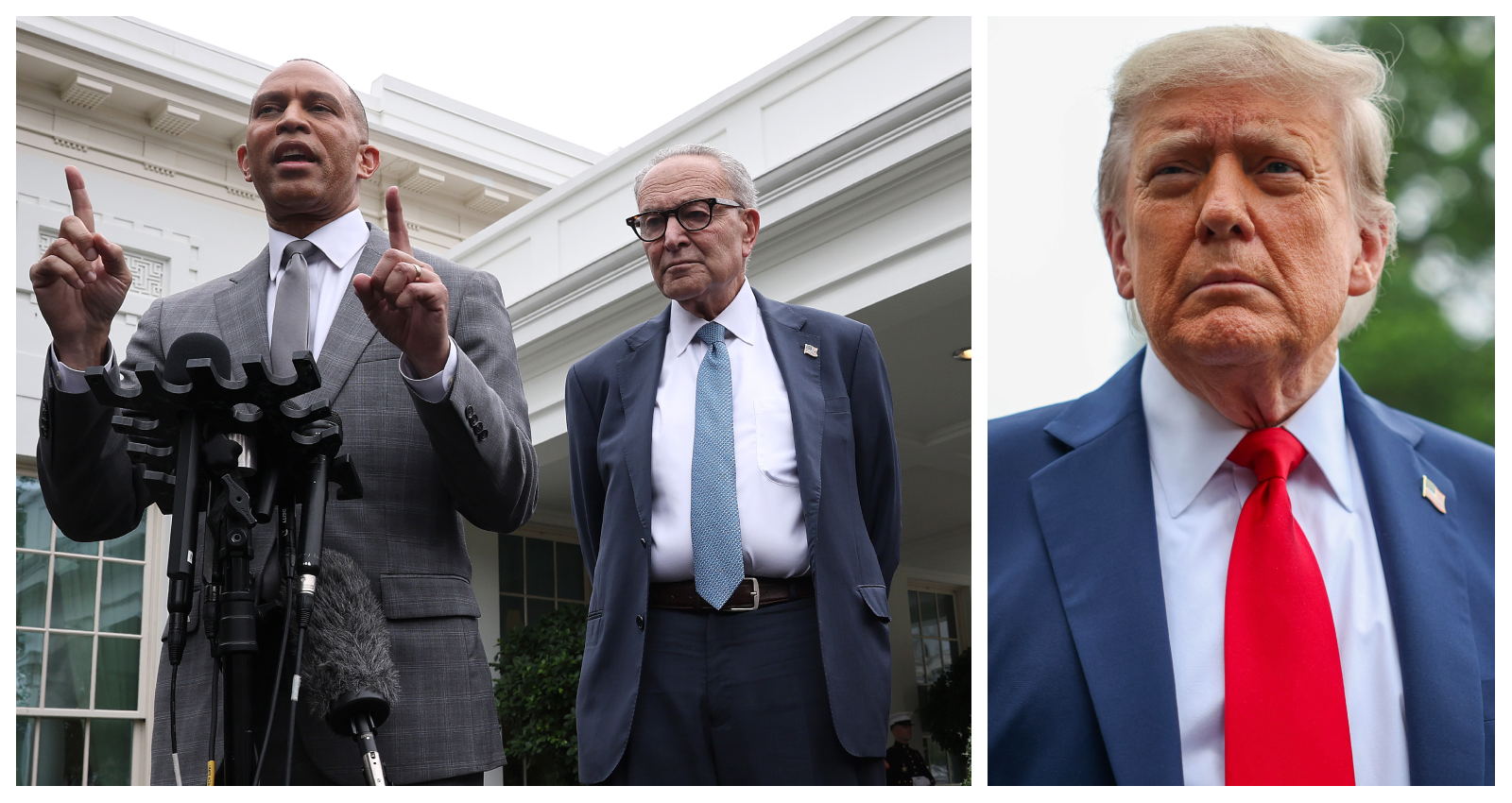
Senate and House Democratic leaders have filed a federal lawsuit seeking to prevent the Trump administration from deploying armed Immigration and Customs Enforcement and FBI agents to polling places during the November midterm elections.
Senate Minority Leader Chuck Schumer, D-N.Y., and House Minority Leader Hakeem Jeffries, D-N.Y., joined the Democratic Senatorial Campaign Committee, Democratic Congressional Campaign Committee and Democratic Governors Association in bringing the lawsuit in U.S. District Court for the District of Columbia.
The complaint asks a federal judge to prohibit armed federal law-enforcement officers from being stationed at or entering polling places except under circumstances specifically permitted by federal law.
Democrats argue that even the prospect of armed immigration or federal law-enforcement officers appearing at voting locations could intimidate some eligible voters and discourage them from casting ballots.
“Notwithstanding federal law, and the traditional sanctity afforded to polling places, the Trump Administration has made clear by word and deed over the past year that it asserts the authority to dispatch armed officers to active polling locations,” the complaint states.
The Democratic leaders accused the administration of threatening a federal presence that they say would violate both federal election law and constitutional protections.
The Trump administration disputes that characterization.
A Department of Homeland Security spokesperson previously said ICE is “not planning operations targeting polling locations.”
DHS has nevertheless left open the possibility that immigration officers could appear at a voting location if agents were pursuing a specific individual or responding to a public-safety threat.
Homeland Security Secretary Markwayne Mullin recently said ICE would not be stationed at polling places simply to monitor voters.
“The only reason why we would be at polling places is if there is a threat to that polling place or we’re serving a warrant on someone that we have been actively tracking down,” Mullin said.
Mullin added that if ICE agents were serving a warrant, “we will be where we need to be.”
Acting Attorney General Todd Blanche has also declined to categorically rule out the presence of federal agents.
Questioned by Sen. Amy Klobuchar, D-Minn., in July, Blanche said he would “follow the law” but would not promise that armed federal agents would never appear at a polling location.
Blanche previously questioned opposition to the idea of ICE officers appearing at polling sites, arguing that noncitizens are prohibited from voting.
The Justice Department says it follows federal law governing election integrity and law-enforcement activities.
The Democrats’ lawsuit centers partly on an obscure federal statute dating to the Civil War era.
Under 18 U.S.C. § 592, federal officials generally may not station “troops or armed men” at locations where elections are being held unless such a force is necessary to repel armed enemies of the United States.
The Justice Department’s own election-crimes guidance acknowledges the restriction.
DOJ guidance states that the department historically has avoided placing law-enforcement personnel inside open polling stations, in part because of state election laws and in part because Section 592 prohibits federal officials from stationing armed personnel where elections are underway.
The restriction does not mean the federal government has no role at polling locations.
The Justice Department’s Civil Rights Division routinely sends civilian election monitors to jurisdictions around the country to ensure compliance with federal voting-rights laws.
Those monitors are fundamentally different from armed ICE or FBI agents conducting law-enforcement operations.
The Justice Department plans to deploy approximately 1,000 federal election monitors during this year’s midterms, substantially more than in previous elections.
The department sent 289 personnel to polling locations during the 2022 midterms.
The Trump administration has not announced a nationwide deployment of armed ICE or FBI agents to polling places.
Democrats are also invoking Section 11(b) of the Voting Rights Act, which prohibits intimidation, threats or coercion aimed at interfering with someone’s right to vote.
Their attorneys argue that armed federal officers do not necessarily have to arrest or question voters to create an intimidating environment.
“The mere prospect of encountering armed federal agents” could cause some voters to stay home, the complaint argues.
This article may contain commentary which reflects the author's opinion.
