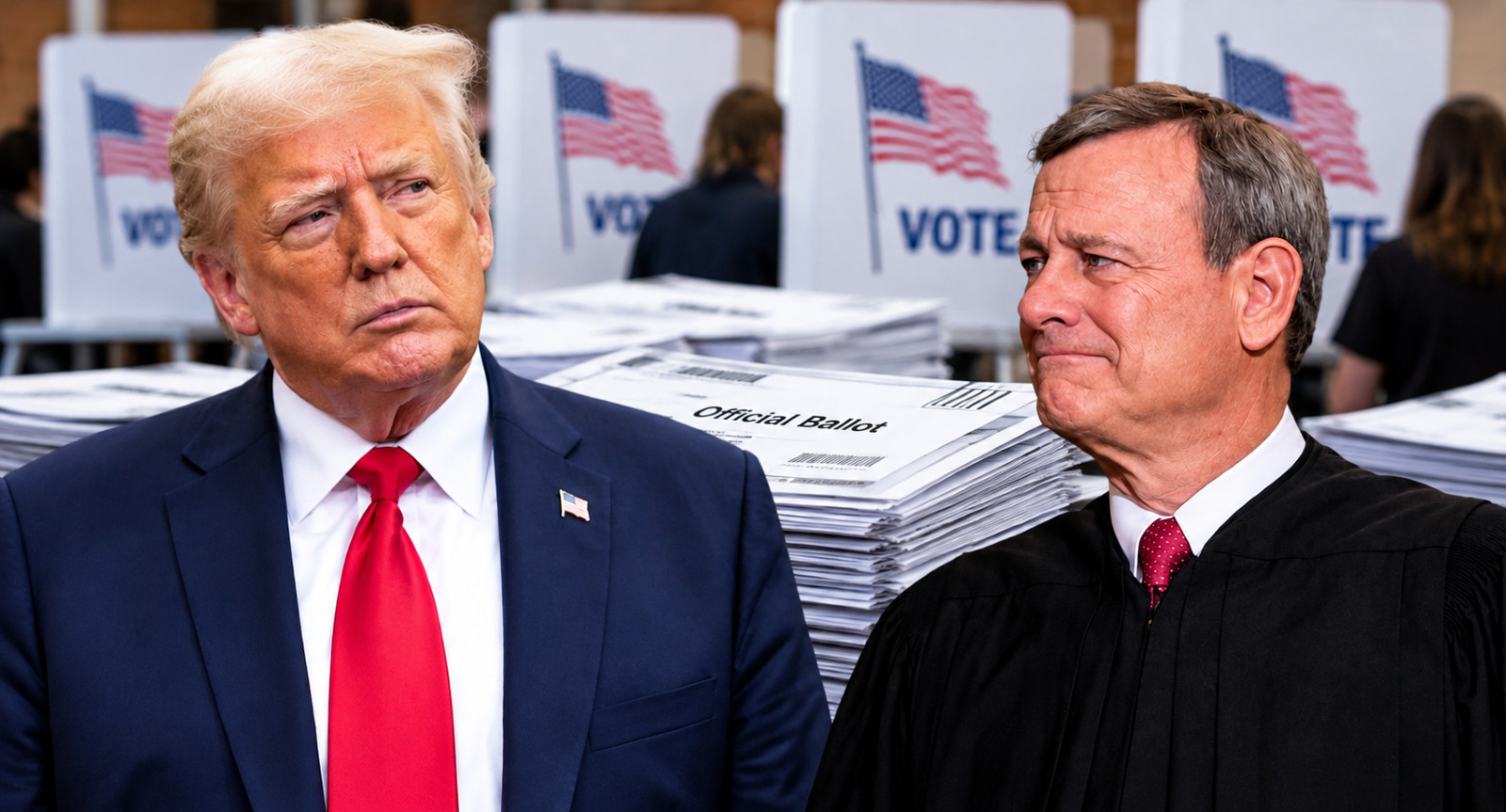
The Trump administration just won again at the U.S. Supreme Court.
The court handed the Trump administration and Republican campaign organizations a legal victory Thursday, temporarily blocking a lower court order that threatened to disrupt discounted political advertising rates just weeks before the November midterm elections.
Chief Justice John Roberts issued an emergency administrative stay preventing the Federal Communications Commission from being forced to immediately resolve a legal challenge brought by four Democratic congressional candidates.
The decision preserves, for now, an FCC policy allowing political party committees and certain joint fundraising organizations to purchase television and radio advertising at discounted rates traditionally available to individual candidates.
The dispute carries significant financial implications as Republicans and Democrats compete for control of Congress in the November 3 elections.
Solicitor General D. John Sauer contended that the appeals court exceeded its authority by intervening before the commission completed its review.
Thursday’s order marks the second time in five weeks that the Supreme Court has intervened in the advertising dispute.
On October 7, the Richmond-based Fourth U.S. Circuit Court of Appeals ordered the FCC to resolve the Democrats’ challenge by noon Friday.
The appeals court accused the agency of deliberately delaying its decision to prevent judicial review before Election Day.
In its 2-1 ruling, the court criticized what it described as the commission’s repeated delaying tactics.
The judges declared that the FCC’s continued inaction could effectively prevent the courts from reviewing the disputed advertising policy before voters head to the polls.
Did the Fourth Circuit Court of Appeals IGNORE a previous Supreme Court order allowing the Federal Communications Commission (FCC) to require a lower advertising rate for both political committees and candidates?!
Chief Justice John Roberts temporarily halted that lower federal court order. Stay tuned…
— Zack Smith (@tzsmith) October 8, 2026
The majority concluded that the agency’s handling of the case amounted to an improper attempt to avoid judicial oversight.
Roberts temporarily suspended that order Thursday, giving the Democratic challengers until Saturday afternoon to respond.
The Supreme Court has not issued a final ruling on whether the FCC’s advertising policy is lawful.
Federal law requires broadcasters to offer qualified political candidates their lowest available advertising rates during specified periods before elections.
The discounts apply during the 45 days preceding a primary election and the 60 days before a general election.
For the November 3 midterms, the general-election discount period began September 4.
Historically, those favorable rates have been reserved for candidates and their authorized campaigns.
However, in March, the FCC’s Media Bureau issued guidance extending the discounts to political party committees making coordinated expenditures with candidates and certain joint fundraising committees.
The change allows qualifying organizations to purchase advertising at substantially lower prices than they otherwise might pay.
For example, a September examination of advertising purchases in Maine found that Republican Sen. Susan Collins and one of her joint fundraising committees each paid $2,200 for a 30-second television advertisement.
A super PAC supporting Collins paid $10,000 for a comparable advertising slot.
The difference illustrates how discounted rates can significantly increase the amount of advertising political organizations can purchase.
The legal challenge was brought by four Democratic candidates: Sen. Jon Ossoff of Georgia, former Sen. Sherrod Brown of Ohio, former North Carolina Gov. Roy Cooper and Rep. Kristen McDonald Rivet of Michigan.
They argue that federal law reserves the lowest advertising rates for candidates rather than political parties and joint fundraising organizations.
The Democrats initially challenged the FCC guidance in April.
After the commission failed to issue a decision, they turned to the federal appeals court.
In August, the Fourth Circuit sided with the candidates and blocked the expanded advertising discounts.
However, the Supreme Court reversed that action on an emergency basis September 4.
In an 8-1 decision, the justices concluded that the appeals court likely acted prematurely because the FCC had not completed its administrative review.
Justice Ketanji Brown Jackson, appointed by President Biden, dissented.
According to Federal Election Commission disclosures, the three major Republican national committees ended August with approximately $233 million in available funds.
Their Democratic counterparts reported roughly $130 million, along with nearly $18 million in debt.
This article may contain commentary which reflects the author's opinion.
