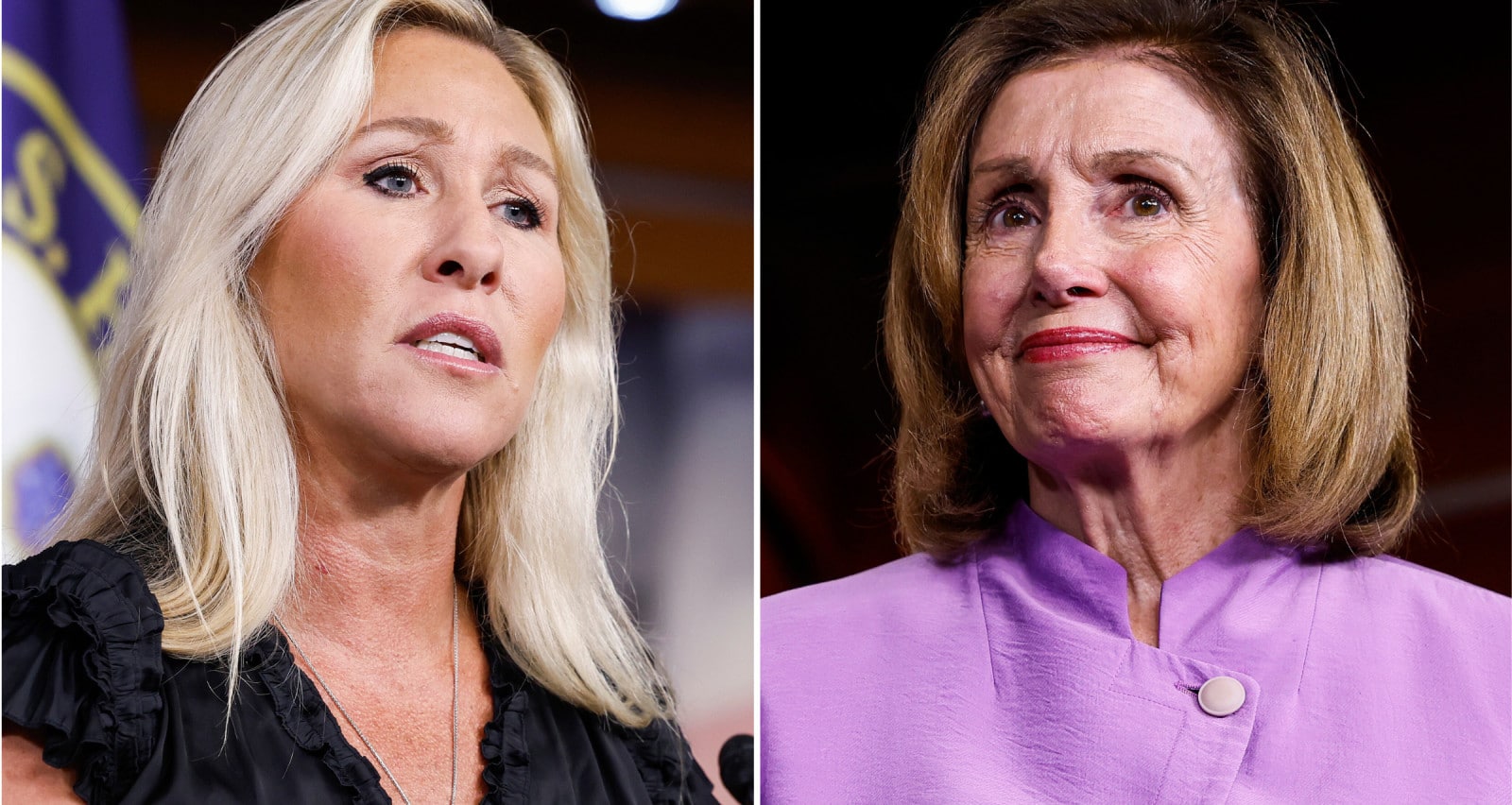
The Supreme Court on Tuesday declined to provide support to three Republicans who had their pay docked in 2021 for disobeying a mask mandate on the House of Representatives floor during the COVID pandemic.
Reps. Tom Massie, Ralph Norman, and Marjorie Taylor Greene filed an appeal in their lawsuit against former House Speaker Nancy Pelosi, but the justices declined it without stating a reason.
Because lower courts lack jurisdiction over the internal rules of Congress, they have declared Pelosi immune to lawsuits.
Attorneys for Louisiana Republican and current House Speaker Mike Johnson agreed with that ruling. The House GOP leaders said to the Supreme Court that “this case is not about the wisdom of the rule or whether it was based on sound science” despite their opposition to the mask rule.
Rather, they claimed, the question is whether the fines are subject to legal challenge.
The three lawmakers who were contesting their fines had contended that they would face reprisals for acting “in accordance with the desires of their district rather than the desires of the Speaker of the House” unless the Supreme Court agreed with them.
When the Republicans cast their vote on the House floor in May 2021, they were contesting a $500 pay deduction for not donning masks.
Separately, the nation’s highest court has been busy lately.
The Supreme Court has been a thorn in President Joe Biden’s side, ruling frequently against his agenda. Now, a new report details how the nation’s highest court appears poised to derail Biden’s plans to further move the country to the left.
For example, Biden’s plans to tax ‘the rich’ could be scrapped soon after the Supreme Court ruled earlier this year that Biden’s $430 billion-plus student loan forgiveness was unconstitutional.
Moore v. United States, for example, could have the greatest influence on Biden, even though the court will hear cases this fall involving the right to bear arms, the authority of federal agencies, and whether the phrase “Trump too small” can be trademarked.
That debate centers on Biden’s frequently expressed desire for a wealth tax and whether it could be implemented.
The central question in the case is, according to the SCOTUS Blog, “Whether the 16th Amendment authorizes Congress to tax unrealized sums without apportionment among the states.” That amendment, of course, allowed the Legislative Branch, for the first time in the country’s history, to legally impose an income tax.
“Reward work, not just wealth. Pass my proposal for a billionaire minimum tax,” Biden said during the State of the Union address earlier this year. “Because no billionaire should pay a lower tax rate than a school teacher or a firefighter.”
“Biden later proposed a 25% annual tax on all gains to wealth over $100 million in a given year, including unrealized capital gains that aren’t currently taxable. The White House says that the tax would only apply to the top 0.01% of the highest earners. While the proposal faces long odds with a Republican-controlled House of Representatives, it could be nixed permanently if the high court rules such a tax is unconstitutional,” The Washington Examiner reported.
Several groups have filed amicus briefs in the case, including the libertarian CATO Institute, which argued that under the Constitution, Biden’s action would be impermissible.
Meanwhile, the Court will hear several cases this fall that offer promising chances to restrain the federal administrative state.
The court has agreed to hear cases that question the constitutionality of a way for agencies to get money that is not subject to the appropriations process or regular oversight by Congress.
The court will also consider cases that question the practice of federal courts agreeing with how agencies interpret the laws they are supposed to enforce.
Additionally, the court agreed to hear a case that might reinstate the jury trial in a category of civil cases that are currently solely in the hands of judges employed by administrative agencies.
One of the most important cases of the upcoming term may be SEC v. Jarkesy because it may reinstate the right to a jury trial in administrative civil cases, the Daily Signal reported.
This article may contain commentary which reflects the author's opinion.
