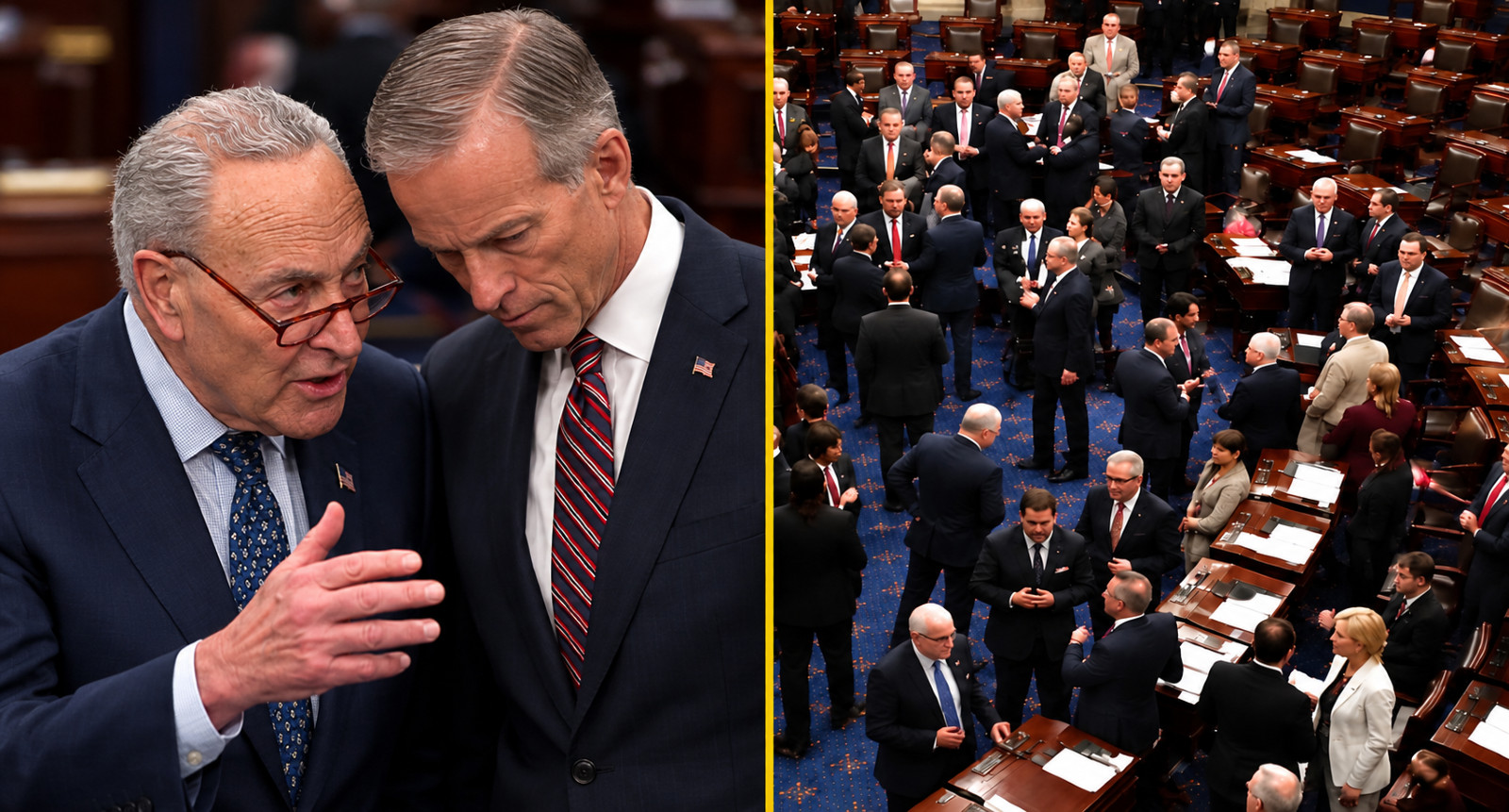
Senator Majority Leader John Thune infuriated Republicans this week by throwing a lifeline to desperate Democrats.
With November’s midterms roughly one month away, Thune fast-tracked two Democrat bills for future floor debate and votes that likely won’t sit well with President Donald Trump.
One bill pertains to protecting presidential memorials from demolition, such as the Trump Kennedy Center.
The other deals with prohibiting the use of taxpayer funds to complete the Trump Arch.
“Thune just fast-tracked legislation to the Senate calendar for future floor debate and votes to prohibit the demolition of presidential memorials like the Kennedy Center and the use of any federal funds for the planning and construction of the Trump Arch,” a C-SPAN producer wrote on X.
The first bill is called the Protecting Presidential Memorials Act, which Democratic Sen. Jeff Merkley introduced with Alaska GOP Sen. Lisa Murkowski.
The additional co-sponsors are all Democrats.
The second is called No Funds for Trump’s Illegal Arch Act, which is authored by Democratic Sen. Angus King and co-sponsored by Democrats.
Thune just fast-tracked legislation to the Senate calendar for future floor debate and votes to prohibit the demolition of presidential memorials like the Kennedy Center and the use of any federal funds for the planning and construction of the Trump Arch. pic.twitter.com/CBqNLteSjJ
— Craig Caplan (@CraigCaplan) September 30, 2026
This comes as the Senate remained in Washington, D.C., this week to pass a slew of bills.
The Senate rejected an effort Tuesday to advance a resolution overturning President Trump’s sweeping 2027 Affordable Care Act marketplace regulations.
Senators voted 48–51 against proceeding to S.J.Res. 197, effectively preserving the Trump administration’s new marketplace framework.
Maine Republican Sen. Susan Collins joined with Democrats to support the measure.
The resolution targeted CMS regulations formally titled the “HHS Notice of Benefit and Payment Parameters for 2027; and Basic Health Program.”
The administration finalized those regulations in May, establishing standards governing ACA exchanges, insurers, brokers, enrollment procedures, subsidies, and marketplace oversight.
The final rule became effective July 20 and contains numerous provisions scheduled to affect marketplace operations beginning in 2027.
Republicans largely defended the administration’s approach, emphasizing program integrity, stronger eligibility verification, consumer choice, affordability, and expanded state authority.
CMS says the rule strengthens protections against improper enrollment while ensuring taxpayer-funded insurance subsidies reach people legally eligible for assistance.
One major provision requires stronger verification when applicants seek marketplace coverage through special enrollment periods outside normal annual enrollment windows.
Federal-platform exchanges must verify eligibility for at least 75 percent of new enrollments occurring through qualifying special enrollment periods.
The administration argues verification can discourage unauthorized enrollment, improve marketplace integrity, and potentially contribute toward healthier insurance risk pools.
Another provision tightens income verification when government data indicates an applicant’s household income falls below 100 percent of poverty guidelines.
CMS says additional verification will help ensure federal premium assistance is distributed accurately while limiting unnecessary taxpayer expenditures.
The government also will no longer automatically accept household income attestations when Internal Revenue Service data is unavailable for verification.
CMS says that change reduces improper enrollment risks, excessive subsidy payments, and unexpected tax liabilities confronting consumers later.
The rule also implements statutory restrictions limiting premium tax-credit eligibility to citizens and federally defined eligible noncitizens beginning in 2027.
Exchanges consequently must verify qualifying immigration status before providing applicable advance premium tax credits and cost-sharing assistance.
Trump’s rule additionally creates stronger oversight targeting potentially misleading marketing practices involving insurance agents, brokers, and online enrollment platforms.
Prohibited practices include using cash incentives for enrollment and falsely suggesting consumers will always qualify for zero-dollar insurance premiums.
Brokers also face requirements governing marketing documentation, allowing federal regulators to review materials during audits and enforcement proceedings.
CMS argues these safeguards should protect Americans from unauthorized policies, misleading advertising, inaccurate eligibility determinations, and unexpected financial consequences.
The rule establishes the State Exchange Improper Payment Measurement program beginning in 2027, expanding federal scrutiny of subsidy payments.
Federal officials already measure improper advance premium tax-credit payments through federally operated exchanges but previously lacked comparable state-exchange measurements.
Under the new framework, state exchanges will provide information enabling HHS to calculate improper-payment estimates and strengthen nationwide accountability.
The regulation also expands flexibility involving catastrophic insurance plans, offering consumers additional options designed around lower premiums and higher cost-sharing.
CMS finalized standards permitting catastrophic plans with terms lasting up to ten consecutive plan years under specified marketplace requirements.
The administration has argued broader catastrophic coverage can increase consumer choice, particularly for Americans prioritizing protection against major medical expenses.
The rule also introduces cost-sharing flexibility for catastrophic coverage and individual-market bronze plans, another component promoting different coverage designs.
Trump has advocated expanding catastrophic options as an alternative for consumers wanting insurance structured differently from traditional comprehensive marketplace plans.
The administration additionally eliminated requirements for standardized marketplace plan options and removed limits governing the number of non-standardized plans available.
CMS says those changes encourage plan innovation and provide consumers greater flexibility when selecting coverage matching individual healthcare preferences.
The rule reduces federal exchange user fees, which CMS says can help lower administrative expenses incorporated into marketplace insurance premiums.
It also gives states additional flexibility concerning provider-access reviews and certification requirements involving essential community providers.
This article may contain commentary which reflects the author's opinion.
