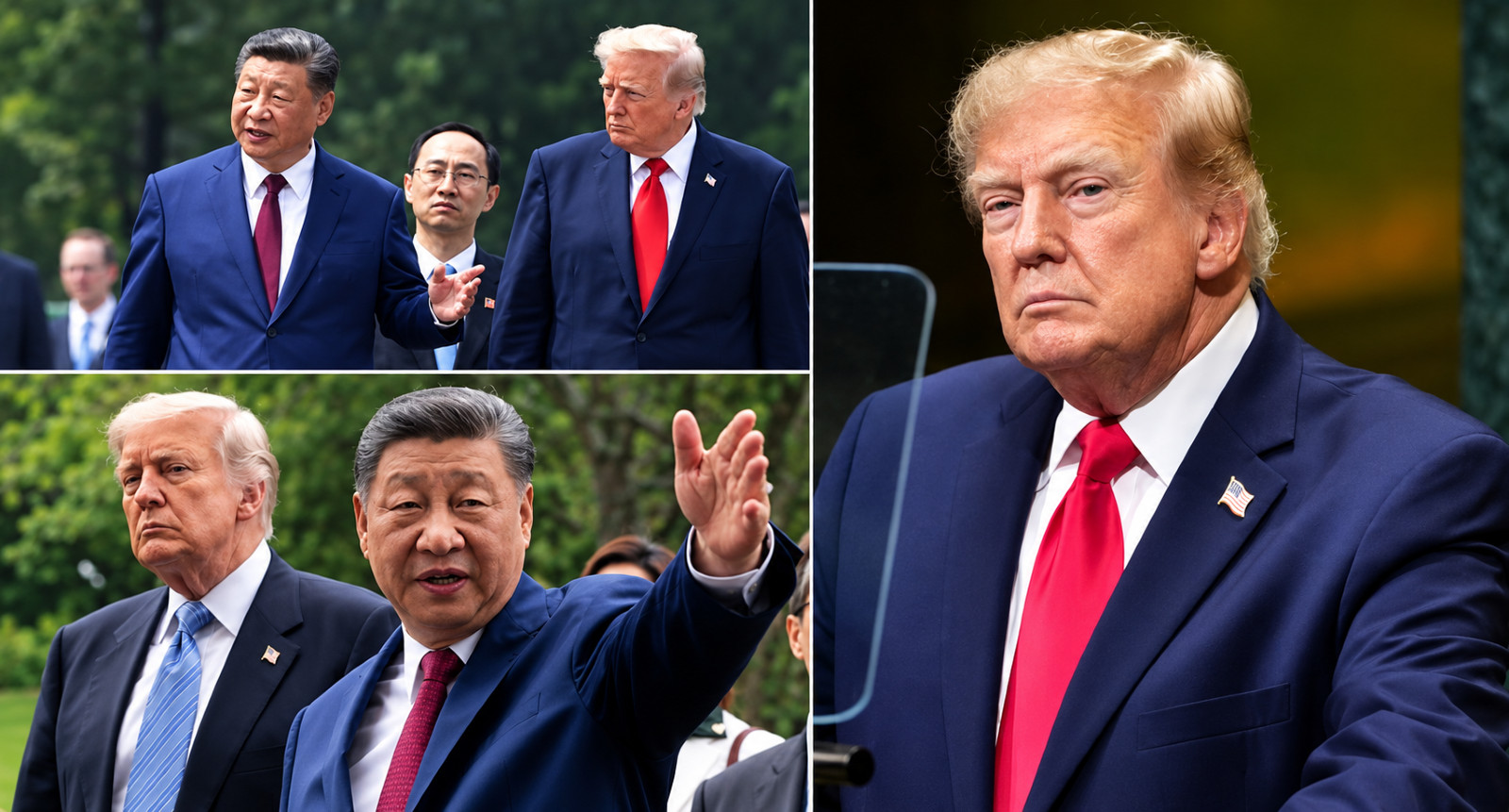
President Donald Trump personally welcomed Chinese President Xi Jinping to the United States on Wednesday evening, beginning a closely watched three-day state visit as Washington and Beijing agreed to extend their fragile trade truce through Jan. 10.
Trump and first lady Melania Trump traveled to Joint Base Andrews in Maryland to greet Xi and his wife, Peng Liyuan, as they stepped off their plane, an unusual presidential gesture ahead of formal meetings between the leaders at the White House.
A 100-foot red carpet was rolled out across the tarmac, where Trump and Xi shook hands, exchanged brief remarks, and posed for photographs. A military band played during the ceremony, which also included ceremonial cannon fire and a flyover by a B-1 bomber.
The greeting marked a break from the more common practice of the president formally welcoming a visiting foreign leader at the White House.
According to C-SPAN records cited by Reuters, Barack Obama was the last president to personally greet a foreign leader at Joint Base Andrews when he welcomed Pope Francis in 2015.
The White House had announced in advance that Trump would meet Xi and Peng at Joint Base Andrews before Thursday’s elaborate state arrival ceremony. Nearly 480 members of the U.S. military will participate in events surrounding the White House visit.
Trump’s decision to personally meet Xi also follows the elaborate reception the American president received during his May visit to China. Trump and Xi met in Beijing during that trip and announced a series of economic agreements intended to stabilize relations between the world’s two largest economies.
Xi’s arrival coincided with another significant development in the economic relationship.
Treasury Secretary Scott Bessent announced Wednesday that U.S. and Chinese negotiators had agreed to extend their existing trade truce through Jan. 10. The agreement had been scheduled to expire Nov. 10.
“I don’t know whether a bigger deal can be done. I don’t know whether we will just roll the current deal,” Bessent said, explaining that the extension provides additional time for negotiations.
The current arrangement has prevented another sharp escalation in the trade conflict between Washington and Beijing. At its most intense point, retaliatory tariffs imposed by the two countries exceeded 100%, severely disrupting trade between them.
The two governments subsequently reached agreements that reduced some tariffs and temporarily suspended additional trade restrictions.
Under an earlier agreement reached by Trump and Xi, China committed to suspend several retaliatory tariffs and restrictions, including measures affecting American agricultural products. Beijing also agreed to make substantial purchases of U.S. soybeans and address American concerns involving exports of rare-earth minerals and other critical materials.
Despite the trade truce, significant disagreements remain.
Trump and Xi are expected to discuss China’s restrictions involving rare-earth minerals, U.S. controls on exports of advanced semiconductor technology, Taiwan, artificial intelligence and Beijing’s relationships with Russia and Iran. Reuters reported that expectations for a sweeping new agreement during the Washington visit remain limited.
Xi, in a statement carried by China’s state-run Xinhua news agency following his arrival, said the two countries should seek a more stable relationship and operate as “partners, not rivals.”
Trump’s elaborate reception for Xi has also drawn criticism from some members of his own party.
Senate Armed Services Committee Chairman Roger Wicker, R-Miss., objected to what he described as a “lavish welcome,” citing continuing disputes with Beijing and concerns about the Chinese Communist Party.
“I don’t think we should be inviting President Xi here based on all of the troubling issues we have with President Xi and the Chinese Communist Party,” Wicker said on the Senate floor ahead of the visit.
The administration, however, is proceeding with extensive ceremonial events.
Trump and Xi participated Thursday in a formal state arrival ceremony at the White House featuring military units and a flyover by a B-2 Spirit bomber accompanied by four F-22 Raptors.
The presidents will then hold bilateral talks before Trump and the first lady host Xi and Peng at a state dinner Thursday evening.
On Friday, the two couples are scheduled to have tea at the White House before visiting the National Archives.
This article may contain commentary which reflects the author's opinion.
