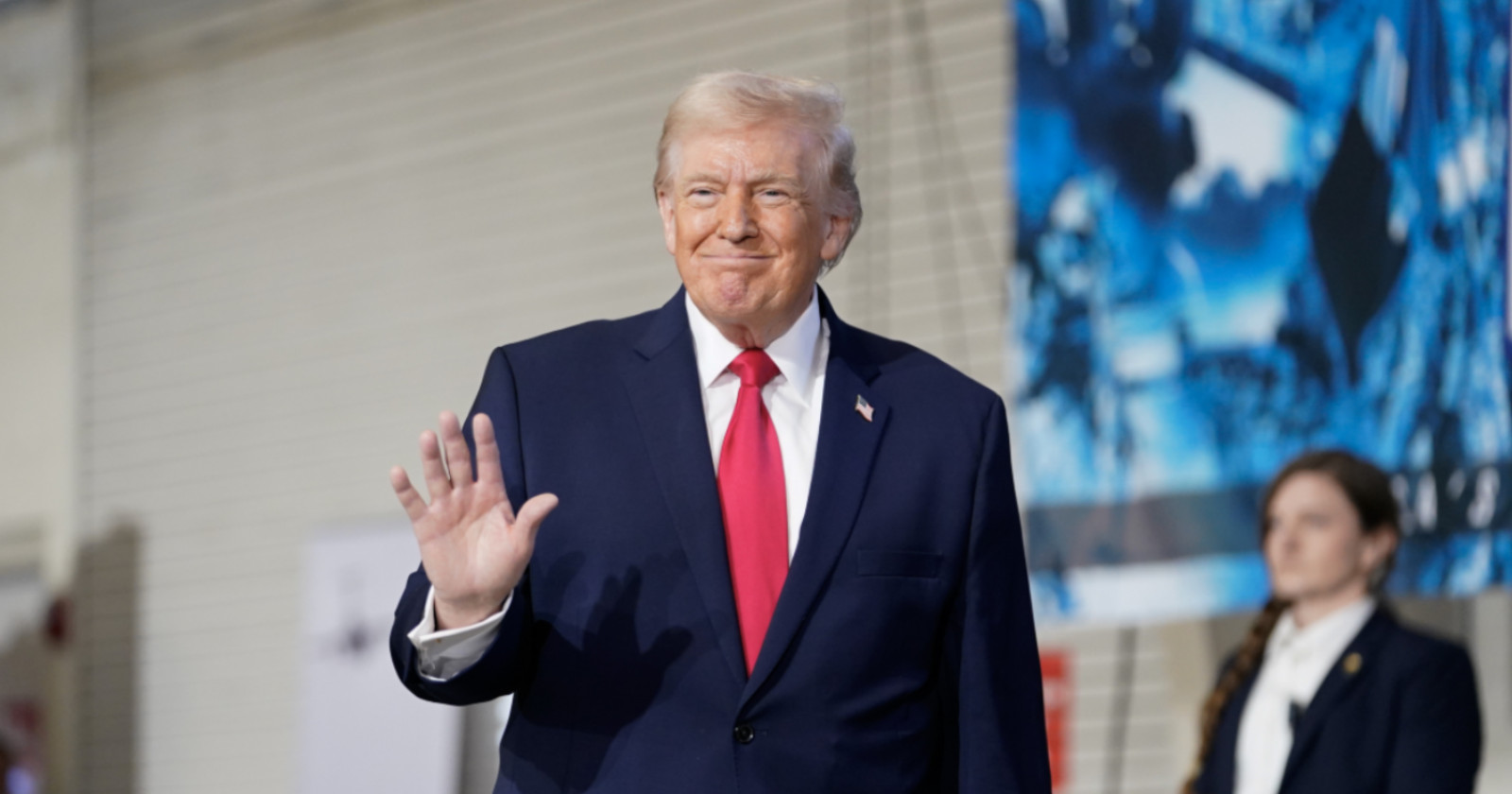
President Donald Trump’s job approval rating stands at 50% nationwide, with 46% disapproving, according to a new national survey conducted by InsiderAdvantage.
The poll, conducted February 17–18 among 800 likely voters, found Trump with a +4 approval margin. The survey used a mixed-mode text and panel methodology and reported a margin of error of plus or minus 3.46%.
The results closely mirror — and slightly exceed — Trump’s national popular vote margin in the November 2024 election.
Respondents were asked: “What is your opinion of the job performance of President Donald Trump?”
- Approve: 50%
- Disapprove: 46%
- Undecided: 4%
InsiderAdvantage pollster Matt Towery said the numbers reflect a rebound following a period of softness in Trump’s ratings.
“After a period of weakness in his approval ratings, President Trump has come back to the 50% level, near to or exceeding his margin of victory against Kamala Harris in 2024,” Towery said. “Other pollsters who also have correctly polled Trump in past election cycles are showing the same upward trend.”
Towery cited improved public perceptions of immigration enforcement and economic movement as contributing factors.
“Basically it is a combination of ICE raids becoming orderly and strategic and obvious evidence that the economy is actually turning to the positive,” he said. He also noted that while a previous government shutdown appeared to hurt Trump politically, “this one appears to be actually helping his numbers.”
Towery added that methodological differences among polling firms continue to produce divergent results, but argued that firms that have historically polled Trump accurately are showing similar upward movement.
“Basically the country is where it is when Trump was elected. Highly polarized, but at the moment, more supportive of Trump than not,” he said.
Separate recent polling suggests that immigration remains one of Trump’s strongest issues.
A Harvard-Harris survey found that most Trump policies remain popular, particularly immigration enforcement. According to that poll:
- 73% support deporting criminal illegal aliens
- 52% support deporting every illegal alien
A plurality approved of the administration’s response to anti-ICE protesters in Minneapolis
A Cygnal poll showed similar results, reporting:
- 61% support deporting all illegal aliens
- 54% support ICE enforcing immigration laws
Taken together, the surveys suggest that while the electorate remains sharply divided, Trump’s approval rating is holding at or above his election performance — with immigration policy continuing to anchor support among likely voters.
The InsiderAdvantage poll was conducted over two days and included likely voters nationwide.
Presidential approval ratings are typically measured through survey samples of U.S. adults who are selected to participate in telephone interviews. Respondents are asked questions about the sitting president’s job performance and whether they approve or disapprove of how the president is handling the office. The modern approval rating system dates back to 1937, when George Gallup pioneered the practice as a way to gauge public support — or dissatisfaction — with the president.
Recently, Gallup announced that it will discontinue its presidential approval polling after 88 years. The organization said the decision reflects an evolution in its research priorities and a shift in how it approaches public opinion analysis and thought leadership.
As of last December, President Trump’s approval rating in Gallup’s tracking surveys ranked among the lowest recorded by the organization since it began polling in the 1930s.
Many Americans often wonder why they are never contacted for these surveys. Polling firms generally rely on sample groups ranging from about 800 to 1,200 participants. The primary requirement is that respondents are registered voters or likely voters, depending on the survey design. However, response rates have become more challenging in recent years, as many people decline to answer calls from unfamiliar numbers. Because traditional approval polls are often conducted by phone, participation can be limited by call screening and general public skepticism toward unsolicited calls.
This article may contain commentary which reflects the author's opinion.
