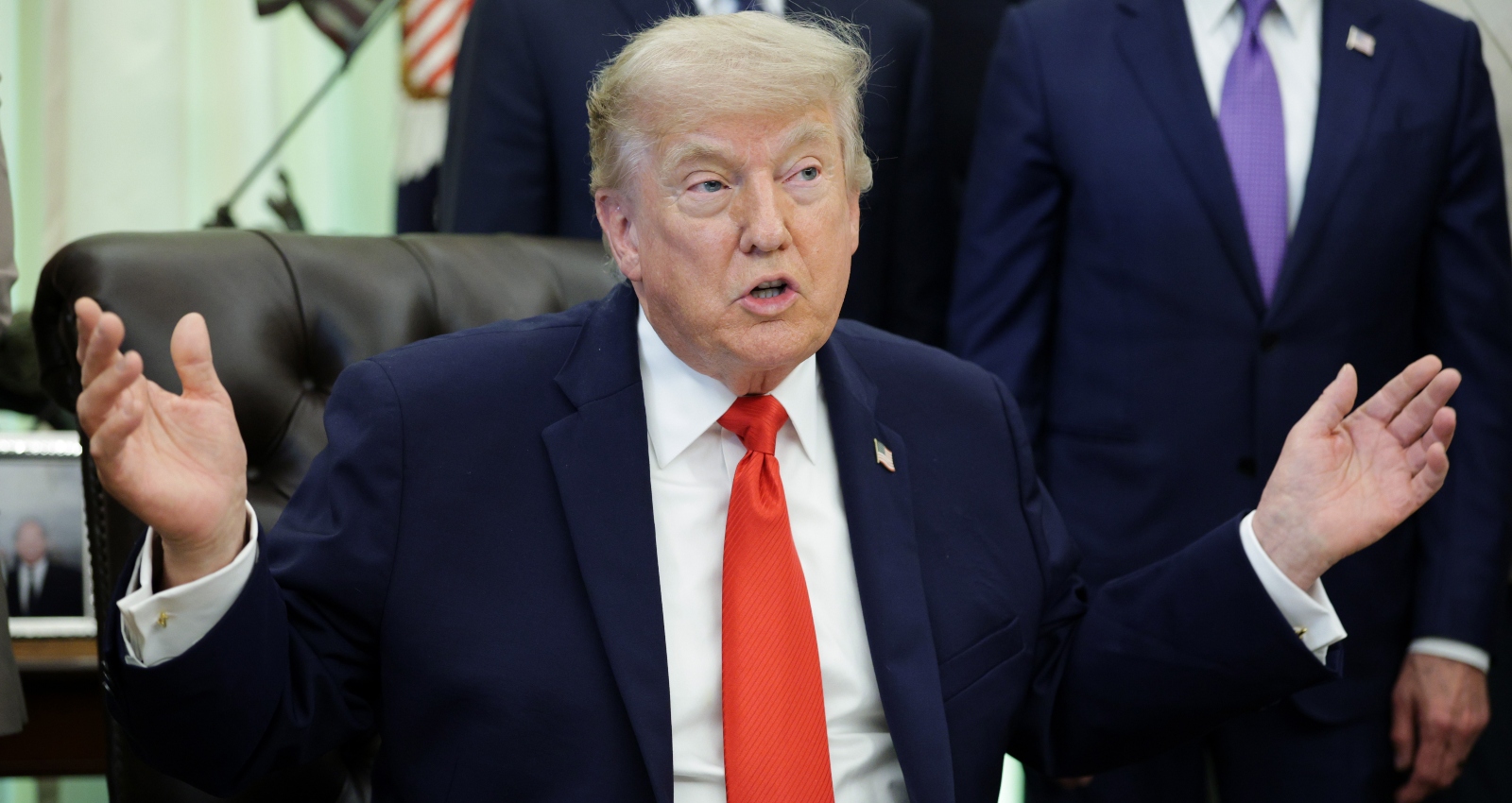
President Donald Trump announced Friday that the United States has reached a major security agreement with Denmark and Greenland that would significantly expand America’s military access to the strategically important Arctic island while leaving Greenland under Danish sovereignty.
Trump unveiled the agreement in a lengthy Truth Social post, portraying the deal as resolving the security concerns that led him to repeatedly push for greater American control of Greenland.
“I am pleased to announce that the United States of America has entered into an Agreement with The Kingdom of Denmark, and Greenland, that gives the United States permanent control over security, and all other needs, in Greenland, completely addressing ALL of our many U.S. concerns,” Trump wrote.
“There will be NO COST to the United States!” he added on his Truth Social page.
Trump said the agreement would give Washington permanent authority to take steps necessary to defend Greenland and the United States.
The announcement marks a potentially significant resolution to a dispute that strained relations between Washington and Copenhagen after Trump repeatedly argued that American control of Greenland was essential to national security.
Denmark and Greenland rejected Trump’s suggestions that the United States purchase or annex the island, insisting that Greenland’s political future could be determined only by its people.
Under the new agreement, that sovereignty will not change.
Greenland will remain part of the Kingdom of Denmark, while the United States receives broader military access and security rights on the island.
Danish and Greenlandic officials emphasized that distinction following Trump’s announcement, making clear that the agreement does not transfer ownership or political control of Greenland to Washington.
Greenlandic Prime Minister Jens-Frederik Nielsen said the agreement protects Greenland’s right to self-determination while strengthening its security relationship with the United States.
The arrangement builds upon a U.S.-Danish defense relationship dating to the Cold War.
The United States and Denmark signed the Defense of Greenland Agreement in 1951, giving Washington extensive rights to operate military facilities on the island as NATO sought to counter the Soviet Union.
The American military presence in Greenland has shrunk considerably since its Cold War peak, but the island remains strategically important.
The United States currently operates Pituffik Space Base in northwestern Greenland.
Formerly known as Thule Air Base, Pituffik plays a major role in missile warning, missile defense and space surveillance.
Its geographic location between North America and the Arctic makes Greenland particularly valuable for detecting missiles approaching the United States from across the polar region.
The new agreement would expand Washington’s ability to establish and operate military facilities elsewhere in Greenland and provide broader basing, access and overflight rights.
Trump described those rights as permanent.
The agreement also reportedly places restrictions on countries outside NATO seeking to establish military facilities or make certain sensitive investments in Greenland.
China and Russia are central to those concerns.
Russia has significantly expanded its Arctic military infrastructure in recent years, while China has sought greater economic and strategic involvement across the region.
Greenland’s importance has also increased as melting Arctic ice creates greater access to shipping routes and natural resources.
The island possesses deposits of rare earth elements and other critical minerals used in military equipment, electronics and advanced technologies.
Those strategic considerations helped drive Trump’s repeated interest in Greenland.
During both his first and second terms, Trump argued that existing American military rights were insufficient and said outright U.S. ownership would provide greater long-term security.
His rhetoric intensified after returning to the White House, with Trump at times declining to rule out economic or military pressure to obtain control of the island.
Those comments drew sharp criticism from Denmark and other NATO members.
The new agreement appears to provide an alternative.
Instead of acquiring Greenland, Washington would receive broader and more durable military rights while Copenhagen retains sovereignty and Greenland preserves its ability to determine its political future.
Trump portrayed that outcome as satisfying his administration’s objectives.
“The United States will FOREVER have the complete ability to do what is necessary in Greenland in order to secure and defend the security of Greenland, and the United States of America,” he wrote.
Some details of the agreement have not yet been publicly released.
Those include the precise locations and scale of additional American military facilities, how the restrictions on non-NATO investment will operate and what infrastructure the United States intends to construct.
The agreement was formally signed during the United Nations General Assembly gathering in New York last week.
This article may contain commentary which reflects the author's opinion.
