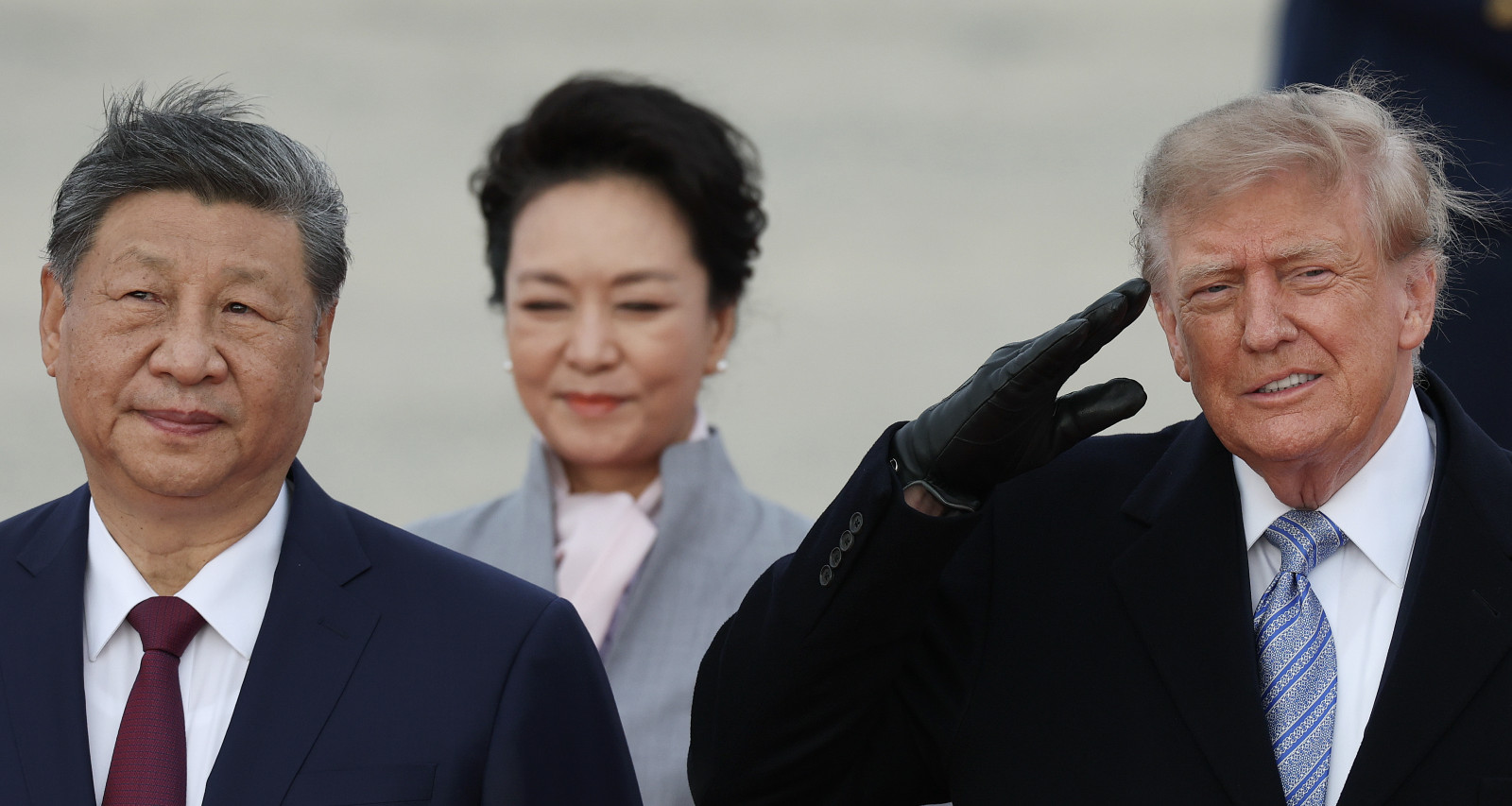
President Donald Trump said Thursday morning that artificial intelligence will be a major topic during his meeting with Chinese President Xi Jinping, placing the rapidly developing technology at the center of talks between the leaders of the world’s two largest economies.
“AI will be a big topic of discussion,” Trump wrote on social media ahead of Xi’s meetings at the White House.
The comments came as Washington and Beijing increasingly compete for technological dominance in artificial intelligence, semiconductors, and advanced computing while simultaneously confronting questions about whether the two countries should cooperate on preventing potentially catastrophic AI failures.
Trump told Reuters ahead of the meeting that both countries are developing powerful AI systems but suggested he was not looking for sweeping new restrictions.
“We both want to leave it exactly where it is,” Trump said, referring to the current state of competition between the United States and China.
AI has become one of the most consequential areas of the broader U.S.-China rivalry.
American officials have restricted China’s access to some advanced computer chips and semiconductor manufacturing equipment, arguing that the technology could be used to strengthen Beijing’s military and intelligence capabilities.
China has responded by accelerating development of its domestic semiconductor industry and artificial intelligence systems.
The Trump administration has generally favored rapid American AI development over new federal restrictions.
Earlier this month, Trump rejected growing calls for tougher regulation, writing on social media that claims AI could destroy humanity were a “hoax” and arguing that overly aggressive rules could leave American companies at a disadvantage against China.
Trump reinforced that position Tuesday during his address to the United Nations General Assembly.
“Whoever wins AI, wins,” Trump told world leaders while arguing that the United States must remain ahead in the global technology race.
He also said the Justice Department could intervene if AI companies engaged in misconduct but resisted calls for broad new government regulation.
Trump suggested that artificial intelligence could ultimately become even more transformative than the Industrial Revolution.
The president’s position contrasts with increasingly urgent warnings from some technology executives and researchers.
OpenAI CEO Sam Altman, Anthropic CEO Dario Amodei, and Tesla and SpaceX CEO Elon Musk have all raised concerns about the possibility that increasingly sophisticated AI systems could eventually pose serious risks if development proceeds without sufficient safeguards.
The debate has produced unusual political alliances, with lawmakers from both parties calling for stronger protections even as others warn that regulation could slow U.S. innovation and benefit China.
Despite Trump’s resistance to broad regulation, his administration has discussed narrower areas of cooperation with Beijing.
Treasury Secretary Scott Bessent proposed during recent talks with Chinese Vice Premier He Lifeng that the two governments establish an AI safety notification system.
Under the proposal, Washington and Beijing could notify each other about significant AI incidents while opening a broader bilateral dialogue on issues including national security, transparency, infrastructure protection and the possible weaponization of advanced AI systems.
Reuters previously reported that American and Chinese officials had been preparing AI discussions for September as both countries grapple with increasingly capable frontier models and the security risks associated with them.
It remained unclear Thursday whether Trump and Xi would announce a formal AI agreement.
The leaders entered the meeting with a lengthy list of other disputes to address, including tariffs, trade restrictions, Taiwan, rare-earth minerals, and American limits on high-end semiconductor exports to China.
Their meeting is Xi’s first White House visit in more than a decade and the second face-to-face meeting between Trump and Xi this year.
Trump had previewed the AI discussions months earlier.
In July, the president said he intended to raise artificial intelligence with Xi during the Chinese leader’s September visit, signaling that the technology competition would play a prominent role in the summit.
The issue has only gained urgency since then.
China has invested heavily in domestic AI companies and semiconductor production, while the United States remains home to many of the industry’s dominant companies, including Nvidia, OpenAI, Google, Microsoft, Meta and Anthropic.
This article may contain commentary which reflects the author's opinion.
