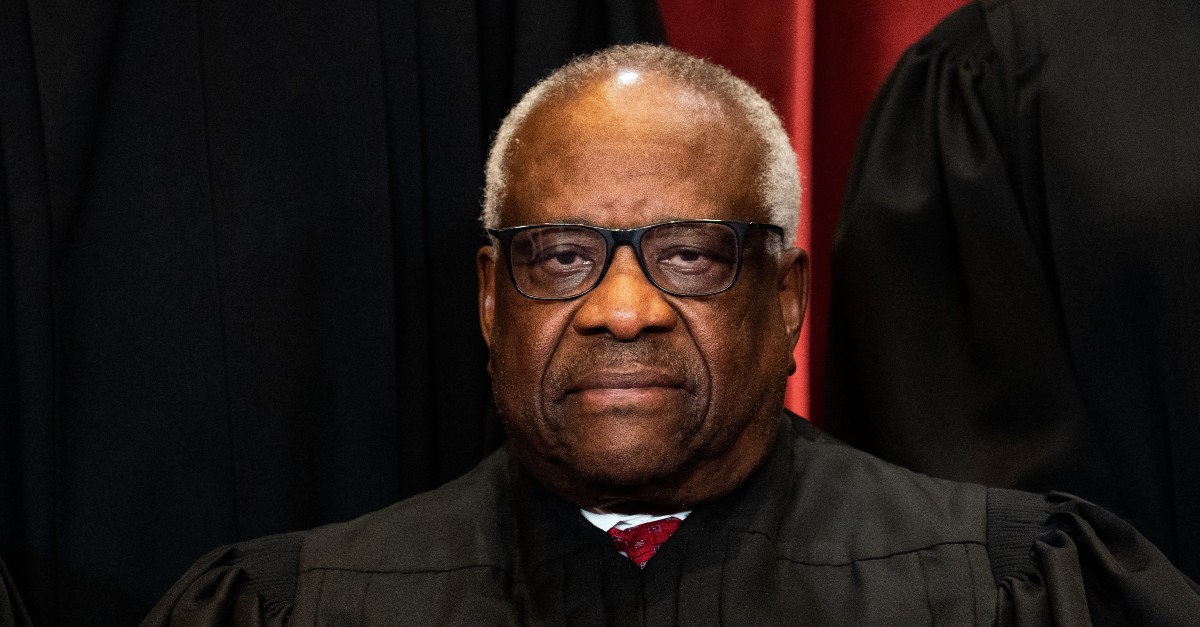
U.S. Supreme Court Justice Clarence Thomas roared back in a case involving free speech and he did not mince his words.
The nation’s highest court heard a case seeking to settle where to draw the line between a town’s right to restrict garish billboard ads and constitutional free speech protections.
“The justices posed difficult questions to both the lawyers supporting and arguing against an Austin, Texas, regulation that permits businesses to use digital billboards on their grounds but bans their use for off-site advertising.”
“The narrow question before the justices was whether the Austin regulation or “sign code,” is triggered by the content of the speech in the advertisement, which would place the regulation in a category that draws the most stringent judicial scrutiny,” The Hill added. “The case stems from 2017 when would-be advertisers, who sought to upgrade dozens of old billboards with digital displays, were denied permits because the signs were located off-premises from their business.”
Justice Thomas asked whether a hypothetical hamburger restaurant would be barred from erecting a digital billboard advertising another restaurant located off-premises.
“[If the sign read] ‘Our hamburgers are great, but if you want great barbecue, go to Franklin’s … that sign would not be acceptable under this ordinance, right?” Thomas asked. “But if I were at Franklin’s, I could say ‘Eat at Franklin’s’?”
The justice continued: “I don’t understand how that’s not content-based if I could say ‘Eat at Franklin’s if I’m at Franklin’s, but I can’t say it if I’m at McDonald’s or some other place.”
Lawyer Benjamin Snyder, who argued on behalf of the U.S. Department of Justice, urged the justices to find that Austin’s restriction of off-premises signs amounts to a constitutionally compatible regulation based on where a digital ad is located, not its content.
Justice Brett Kavanaugh, who was appointed by President Donald Trump, asked if there was a way Austin could allow a less restrictive sign code that allowed for more range with content.
“Can’t they achieve the interest by placements, number, and size restrictions rather than anything that has to do, arguably, with the words that are written on the sign?” Kavanaugh asked.
“If you think about walking through a downtown area that didn’t have on-premises signs up,” Snyder explained, “it would be impossible to find the store or the church that you were trying to get to. And so on-premises signs serve that function in a way that off-premises signs just don’t.”
“A number of states don’t use this distinction,” Kavanaugh replied. “I don’t know if people are just running around lost in all those states, but they presumably find their way to the place.”
“Chief Justice John Roberts pointed to the possibility of rendering unconstitutional portions of the Highway Beautification Act, a 1965 statute that relied on the on- and off-premises distinction to let states regulate highway signs. Kannon Shanmugam, a lawyer for the advertisers, argued that such laws should be subject to strict judicial scrutiny but suggested they might survive the test where Austin’s sign code fails,” The Hill reported.
“But both Roberts and Justice Elena Kagan expressed concern that such an approach could risk diluting the legal standard, known as strict scrutiny when applied to content-based restrictions,” the report added. “Kagan appeared to indicate that she would prefer a legal principle that could filter out otherwise harmless content-based regulations, citing the example of restrictions that only allow illuminated signs for the purpose of making one’s address more visible.”
“There are some laws that sort of scream out not to worry, in terms of any First Amendment values,” Kagan said.
“The thing not to worry about is drawing some kind of sensible line, which takes laws like this one, and puts it on the other side of the content-neutral, content-based divide,” she added later.
This article may contain commentary which reflects the author's opinion.
